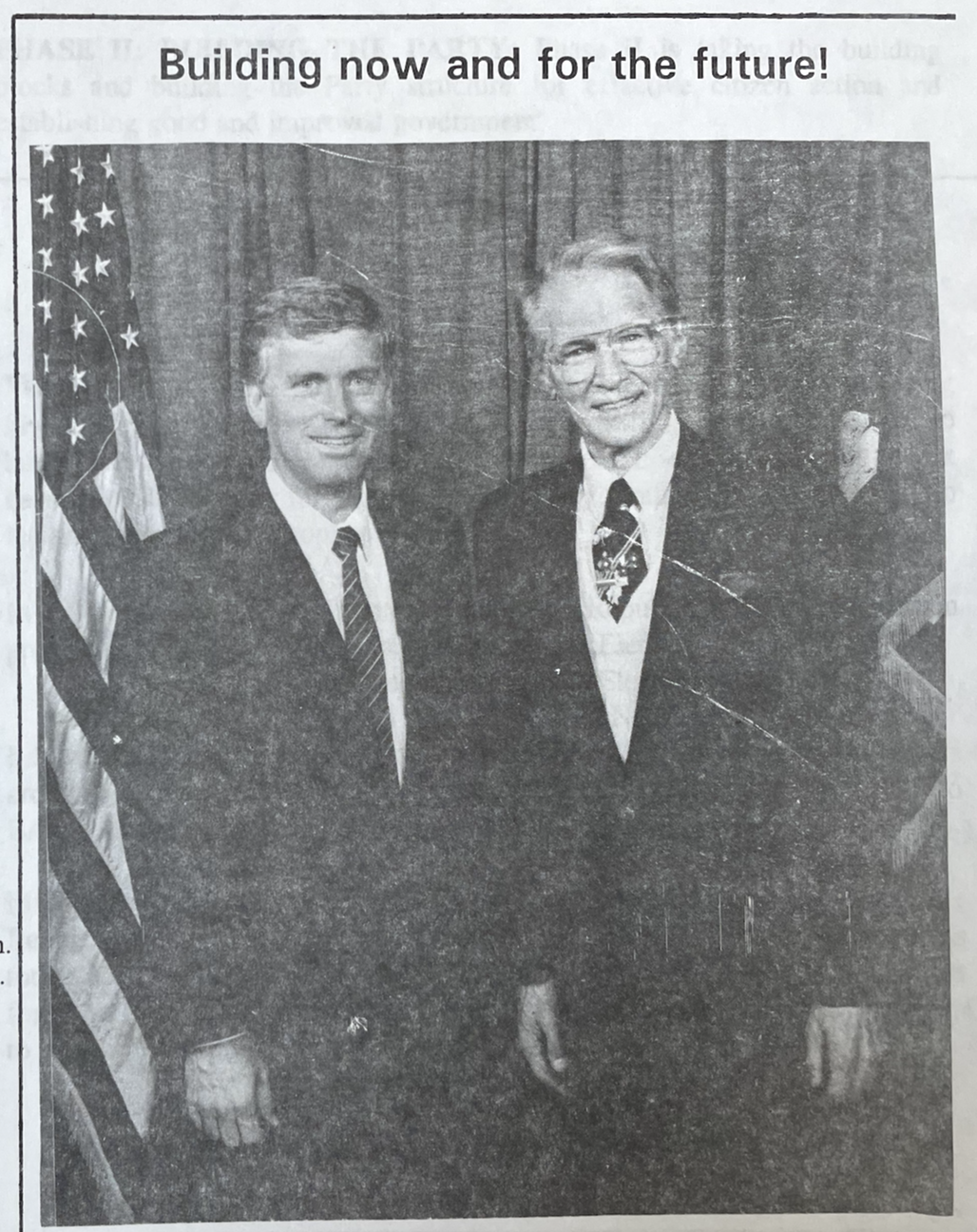
Bob Packwood and the Mirage of the Moderate Republican
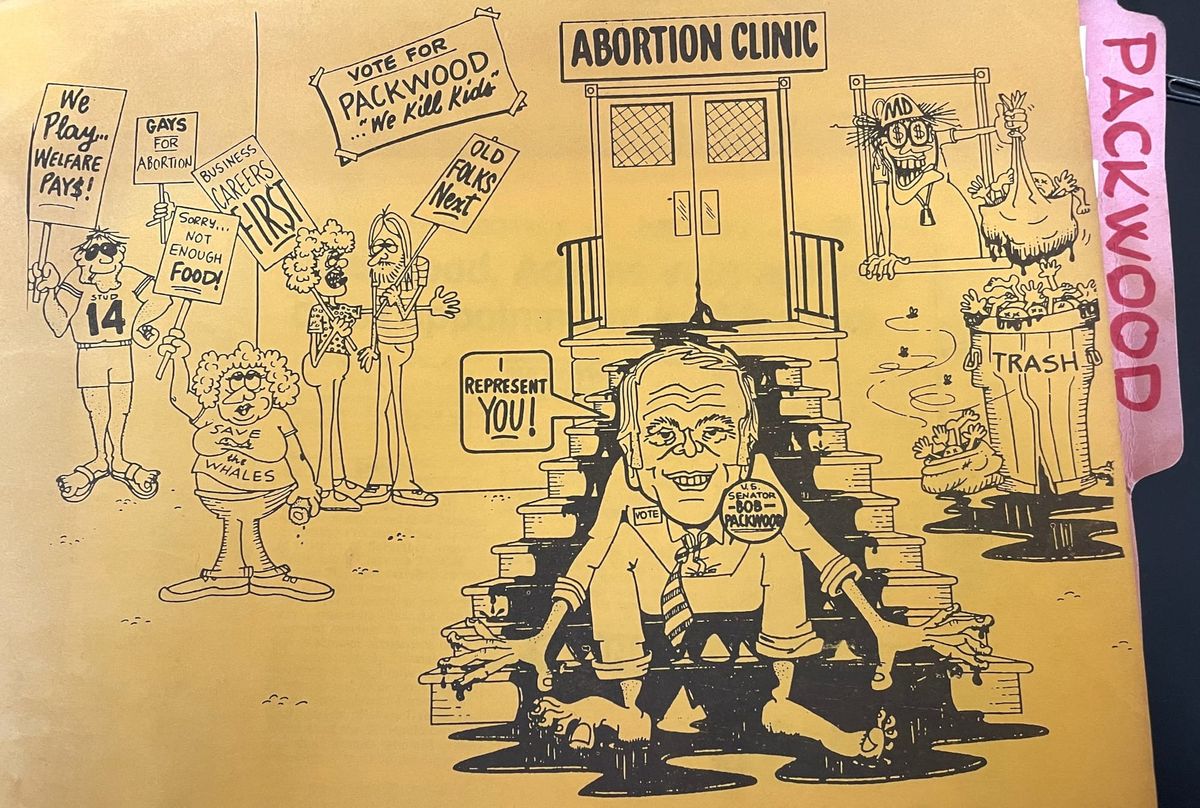
Throughout his 60 year career in politics, Senator Bob Packwood was the quintessential moderate Republican. Like the other leading lights in the Oregon Republican Party from the 1960s into the 1980s--Governor, then Senator Mark Hatfield (1958-1996), Governor Tom McCall (1966-1974), Governor Vic Atiyeh (1978-1986), Secretary of State Norma Paulus (1976-1984), Attorney General Dave Frohnmeyer (1980-1990), Attorney General Hardy Myers (1996-2008), and many others–Packwood's centrist politics stand in stark contrast to the MAGA-fied nature of today's OR GOP. Packwood's center-left voting record on issues such as abortion access, gun control, women's rights (his sexually violent interpersonal behavior to the contrary), environmental protections, and civil rights, put him firmly in the mainstream of the Cold War era's bipartisan, "liberal consensus."
Historian Erik Loomis has written an excellent, thorough obituary of Packwood (linked below) so I won't strive for comprehensiveness in this post. Rather, I want to focus on what I know best--the right wing Oregon Republicans who despised Bob Packwood from the beginning of his career in 1960 up until the very end in the 2020s. Despite the formidable power Packwood wielded as a 5-time elected US Senator, he constantly had to contend with the increasingly organized, far right, illiberal elements inside his own party. Those "good old days" when political moderation and reality-based statesmanship defined what it meant to be an Oregon Republican were, in many ways, a mirage of wishful thinking perched perilously atop a Republican activist base and electorate that yearned for politicians who were not a bit more conservative than Packwood, but rather embodied a radically different brand of politics [insert Trump voice] "like nobody has ever seen before."
 Erik Loomis
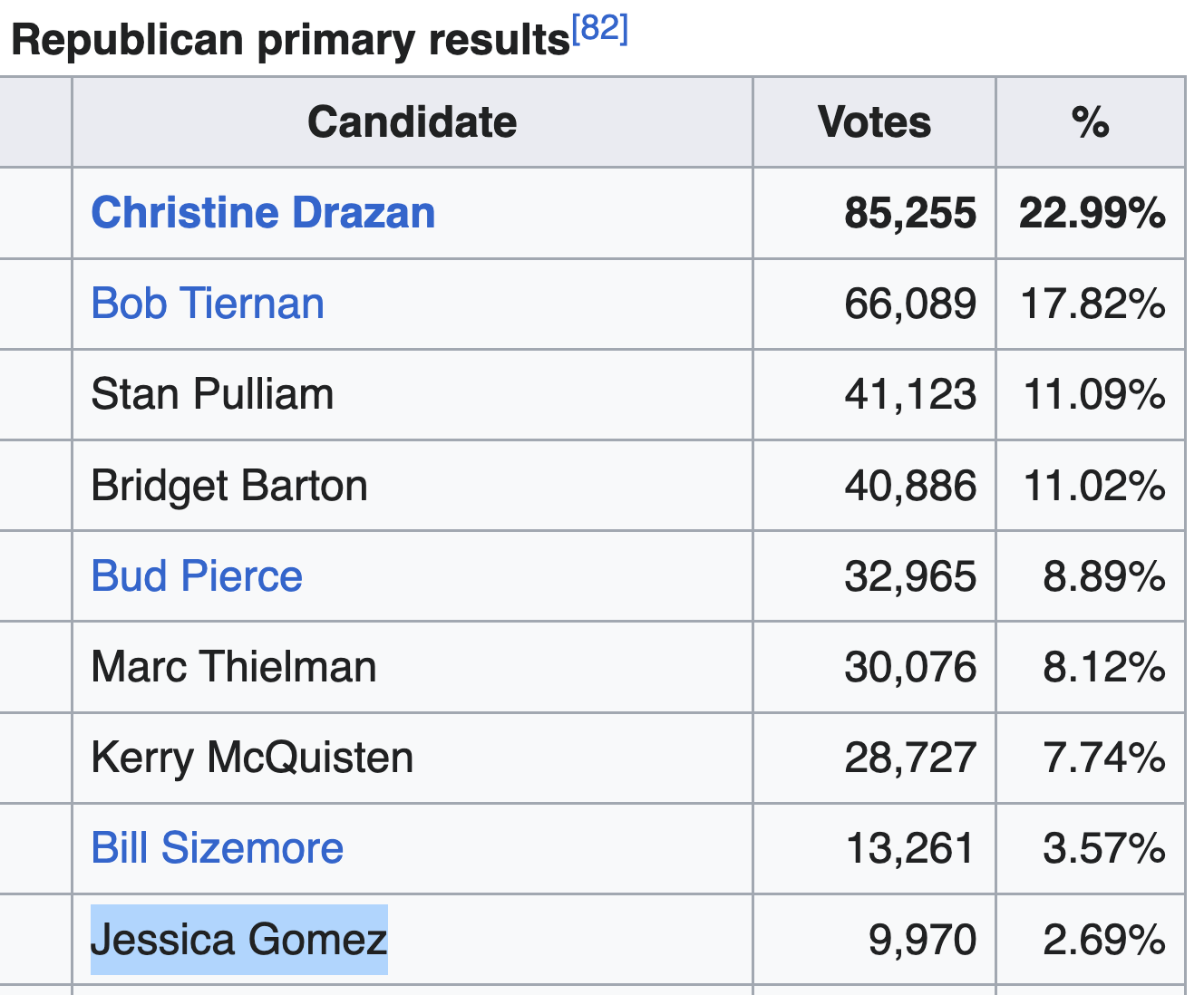
Let me tell two stories bookending Packwood's career that flesh out what I mean when I call moderate Oregon Republicanism a "mirage." When I interviewed Senator Packwood in July 2022, he still thought of himself as a mover and shaker in Oregon Republican politics. He spoke very enthusiastically about Jessica Gomez, a moderate Republican gubernatorial candidate on whose behalf he and his wife had worked in the most recent primary. Like most Oregonians, I'd never heard of Gomez. When I read up on her background and policy positions I saw why Packwood regarded her as someone who, like him, could appeal to independent and even Democratic voters. If I had to live under a Republican Governor, Gomez seems like the best case scenario (from my perspective) as to what that would look like. The only problem, however, is that despite how impressive I or Packwood might have found her, Republican primary voters could have cared less. "Moderate Republican Governor Gomez of Oregon" was and almost certainly will be, until the state and national Republican Party transforms into something radically different from what it is today, an alluring mirage in the mind of Bob Packwood.
Story number 2 is from the very beginning of Packwood's career in the early 1960s. I told that story at much greater length in an earlier Rightlandia post, but I'll summarize it briefly here.
 Seth Cotlar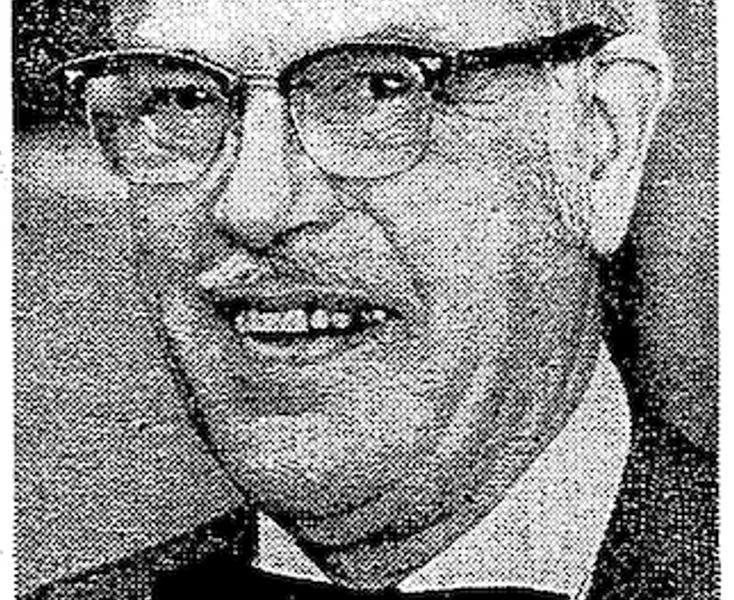
Packwood got his start in Oregon Republican politics in 1960 when, at the age of 28, he was elected chair of the Multnomah County Republican Party. That same year, a 42 year old Foursquare minister, anti-communist crusader, and white Christian nationalist named Walter Huss moved back to his hometown of Portland to begin organizing his fellow right wingers with the goal of taking over the Oregon Republican Party.
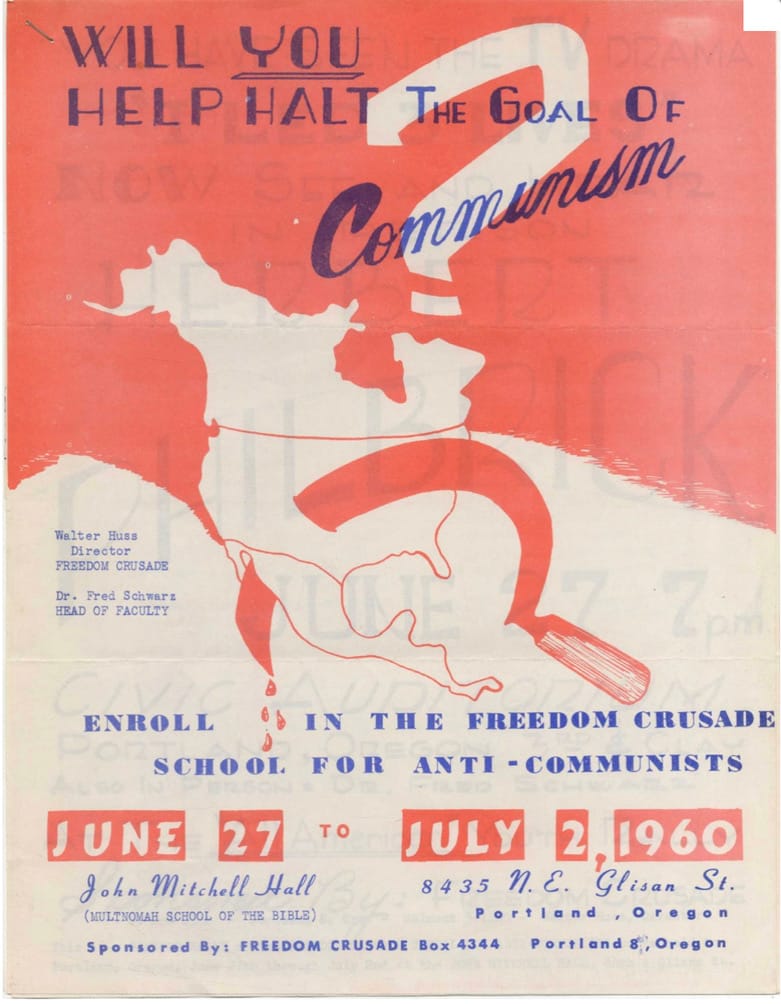
From the very beginning of Packwood's career as an Oregon Republican, he battled with self understood "conservatives" like Walter Huss who considered Packwood's liberalism on social issues to be little more than a trojan horse for Communism. When Packwood attended NYU law school in the 1950s, he made it a point to spend time in the orbit of NYC's liberal Republican lion Jacob Javits, precisely the sort of Jewish, pro-civil rights Republican that Huss, the racist antisemite, "knew" was a secret agent of the international Communist conspiracy.
In June of 1962 Packwood stepped down as chair of the Multnomah County GOP to make his first run for state legislature. Huss organized a slate of far right candidates to run against Packwood's hand-picked successors, and Huss's slate came within a few dozen votes of winning. I've spoken with former Portland State University professor Charlie White who attended that meeting. He described it as a highly dramatic event packed with scores of grassroots far right activists, mostly white working class evangelicals from the eastern outskirts of Portland who were quite new to organized party politics. When the final vote tally was announced, confirming the victory of Packwood's moderate/establishment faction, one elderly working class woman from Huss's group fainted and fell into the aisle from the disappointment.
While Charlie White never forgot this dramatic 1962 battle royale between establishment moderates and populist right wingers in a packed Portland auditorium, Bob Packwood seems to have completely wiped this moment from his memory banks. I asked him in 2022 when he thought the far right started to get a foothold in the Oregon Republican Party. He said "2010 and the Tea Party." When I told him I was writing about Walter Huss he chuckled dismissively and said "why would anyone want to write about that kook?" He looked through his diaries and they contained almost no mentions of Walter Huss. I was tempted to say "maybe if you'd paid a bit more attention to Walter Huss you'd understand why all of the time and energy you invested in Jessica Gomez earned her a whopping 2% of the GOP primary vote a few months ago," but I held my tongue.
Those “conservative” populists who almost took over the Packwood-controlled Multnomah County GOP in 1962 advocated for a politics that was not just slightly to Packwood's right. Rather, they embraced a form of conspiratorial, anti-government illiberalism that marked a difference in kind, not of degree. Packwood thought top marginal tax rates should be lower so as to encourage economic growth. His far right opponents wanted to return to the gold standard and abolish the federal income tax. The leaders of the group like Walter Huss and Sylvester Ehr (both former Silver Shirts from the 1930s) thought the graduated income tax and the Federal Reserve had been unconstitutionally imposed upon the country by the international Jewish/communist conspiracy which parasitically used those institutions to suck the lifeblood out of hard working white Christian Patriots like them. Bob Packwood thought Black Americans should have the same legal and political rights as all Americans. His opponents thought Black people were a) biologically inferior and b) should just be grateful for how wonderful their lives were in the United States. Huss thought the civil rights protests of the early 1960s were inauthentic events conjured up by cunning Jewish communists who controlled the media and were cynically using Black people to sow divisions amongst Americans, ripen up the country for revolution, and facilitate the emergence of a one-world, Jewish/Communist dictatorship. The most “moderate” participants in Huss's anti-Packwood insurgency ca. 1962 would have largely agreed with these positions, but maybe thought the stuff about the Jews was a bit much.
None of this right wing ferment inside the Multnomah County GOP from the very beginning of Packwood's career in Oregon politics seems to have registered with him. His faction won in 1962, beating back this insurgency of right wing "kooks" and working class evangelicals from the more run down parts of town, so why look back when there were so many more victories that lay ahead?
Probably the defining moment in Packwood's early career came in 1964 when he was a first term Republican state representative. Barry Goldwater's shellacking at the hands of LBJ in November 1964 had a massive tail effect on Republican electoral fortunes in every state but one, Oregon. Thanks to a slate of strong moderate Republican candidates Packwood had personally recruited, Oregon was the only state where the GOP gained seats at the state level. Packwood took that victory to be "proof of concept" for his vision of a moderate OR GOP that could reliably win general elections.
The year following Goldwater's defeat, Packwood organized an annual (and ongoing) gathering called the Dorchester Conference that was designed to advance the cause of moderate Republicanism and fend off the challenge from the right. Within a few years, however, Dorchester had largely ceased to function as a force for moderation. These days, 60+ years after its founding, the Dorchester Conference is a run-of-the-mill MAGA Republican event like you'd find just about anywhere in the country. In 2018, for example, the Dorchester's keynote speaker was Roger Stone. Alex Jones tweeted a picture of Stone flashing a white power hand gesture with some local Proud Boys in the conference bar.
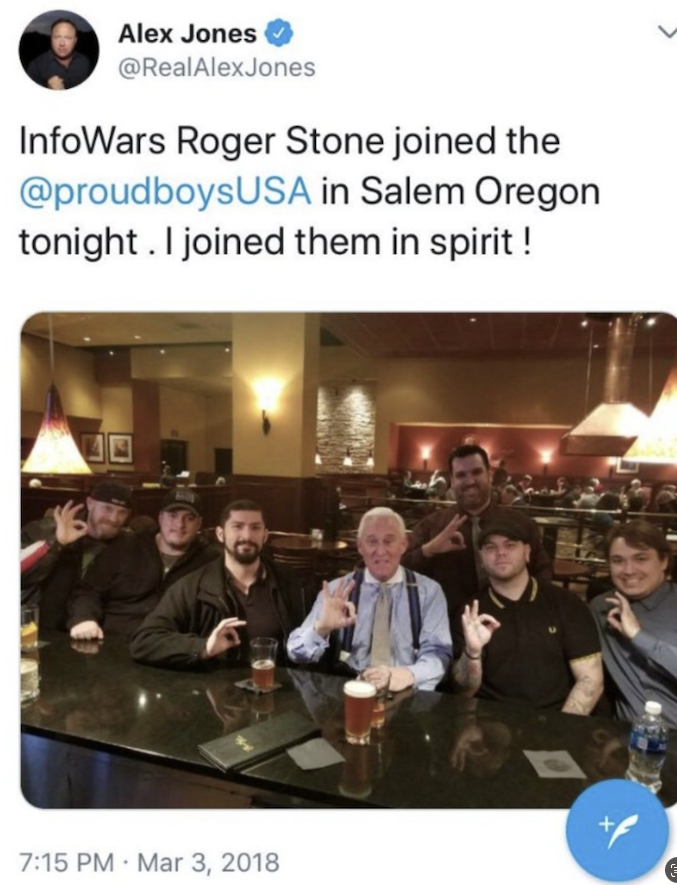
Even though Dorchester quickly became a standard-issue Republican event, we shouldn't be too cynical about Packwood's initial intent for the conference to serve as a force for moderation. For a few years in the mid-1960s Packwood worked to "deliberately exclude" from his event most conservatives, let alone right wing extremists like Walter Huss, Roger Stone, or the Proud Boys. Packwood hoped to convince OR GOP leaders and donors that taking the Bircher/Goldwater route would doom the party's electoral fortunes.
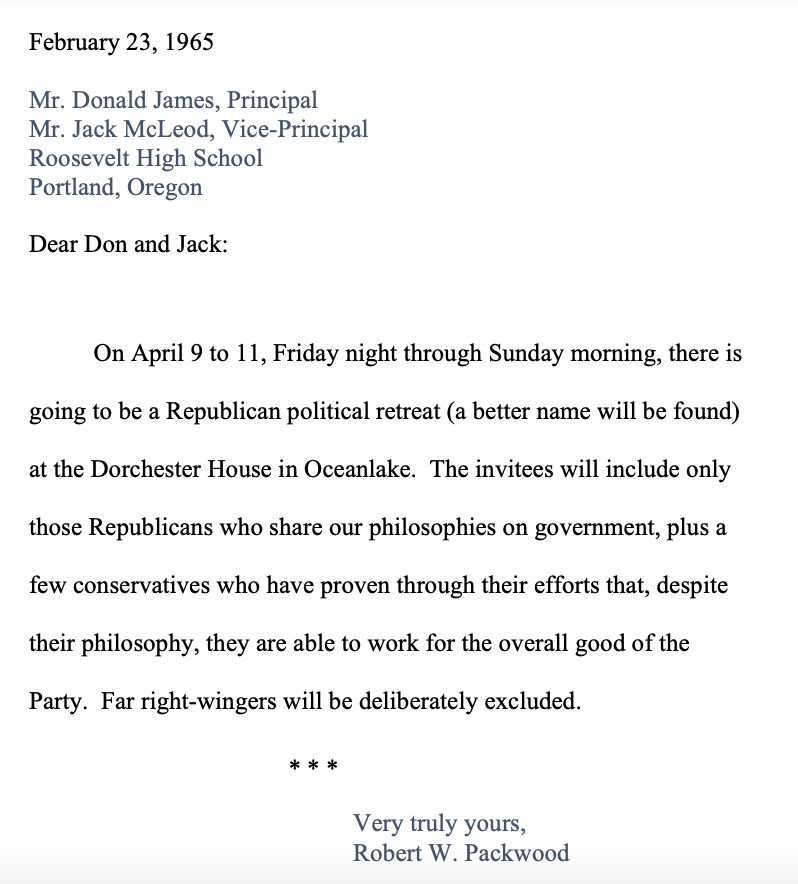
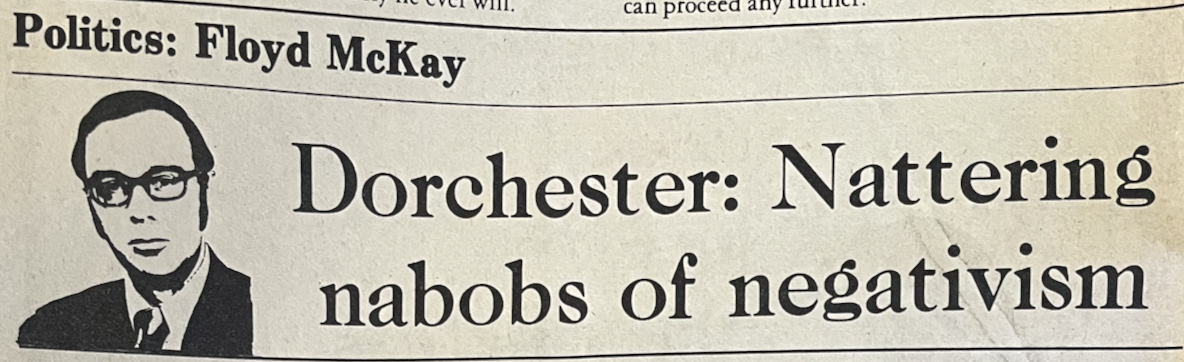
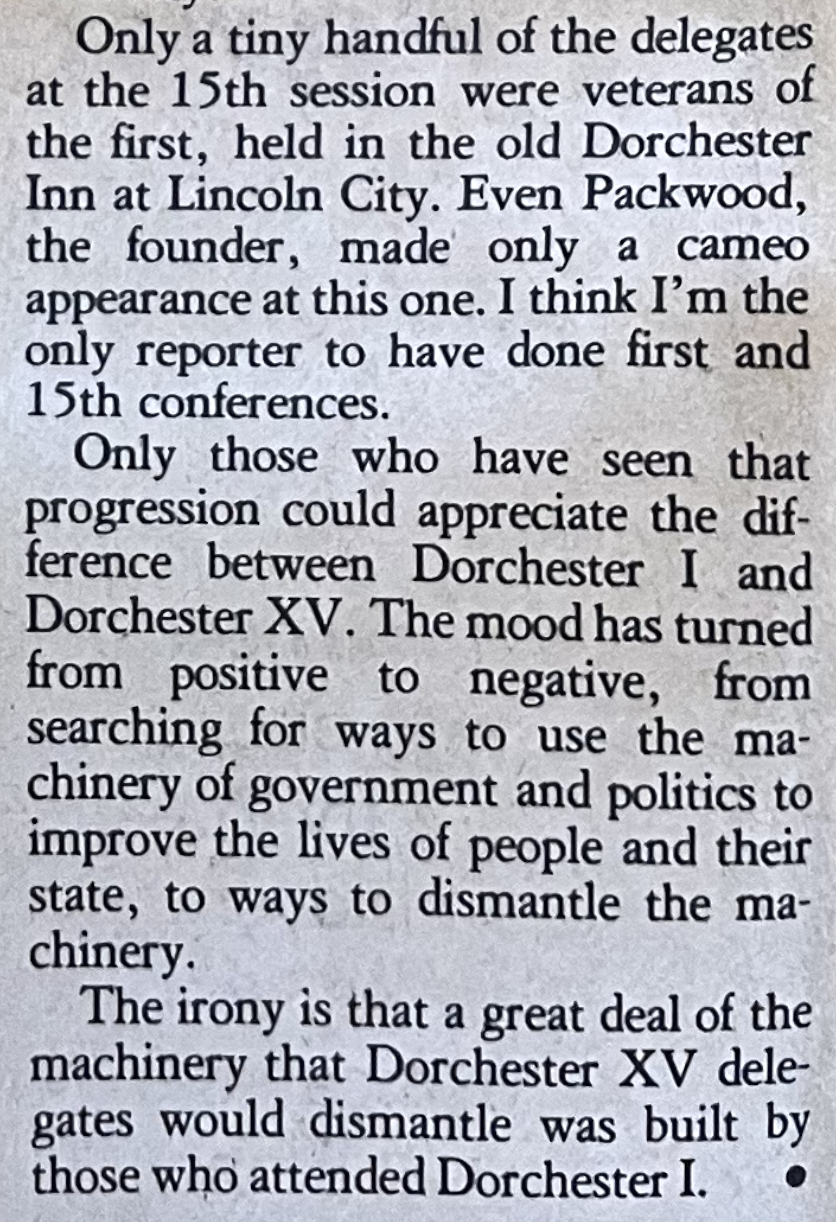
While Packwood's initial enthusiasm for building a moderate Oregon GOP was authentic, within only a few years he'd basically gave up trying to enforce any sort of ideological litmus tests at Dorchester and it became a "big tent" event that reflected the full spectrum of the rightward drifting Republican coalition. Indeed, even that "far right-winger" Walter Huss attended Dorchester a few times, the last time being 1979 when the plot to oust him as OR GOP chair was hatched under his nose at that year's gathering. Floyd McKay's Willamette Week report from that March 1979 Dorchester Conference provides a sense of just how much the spirit of the event had changed since 1965.
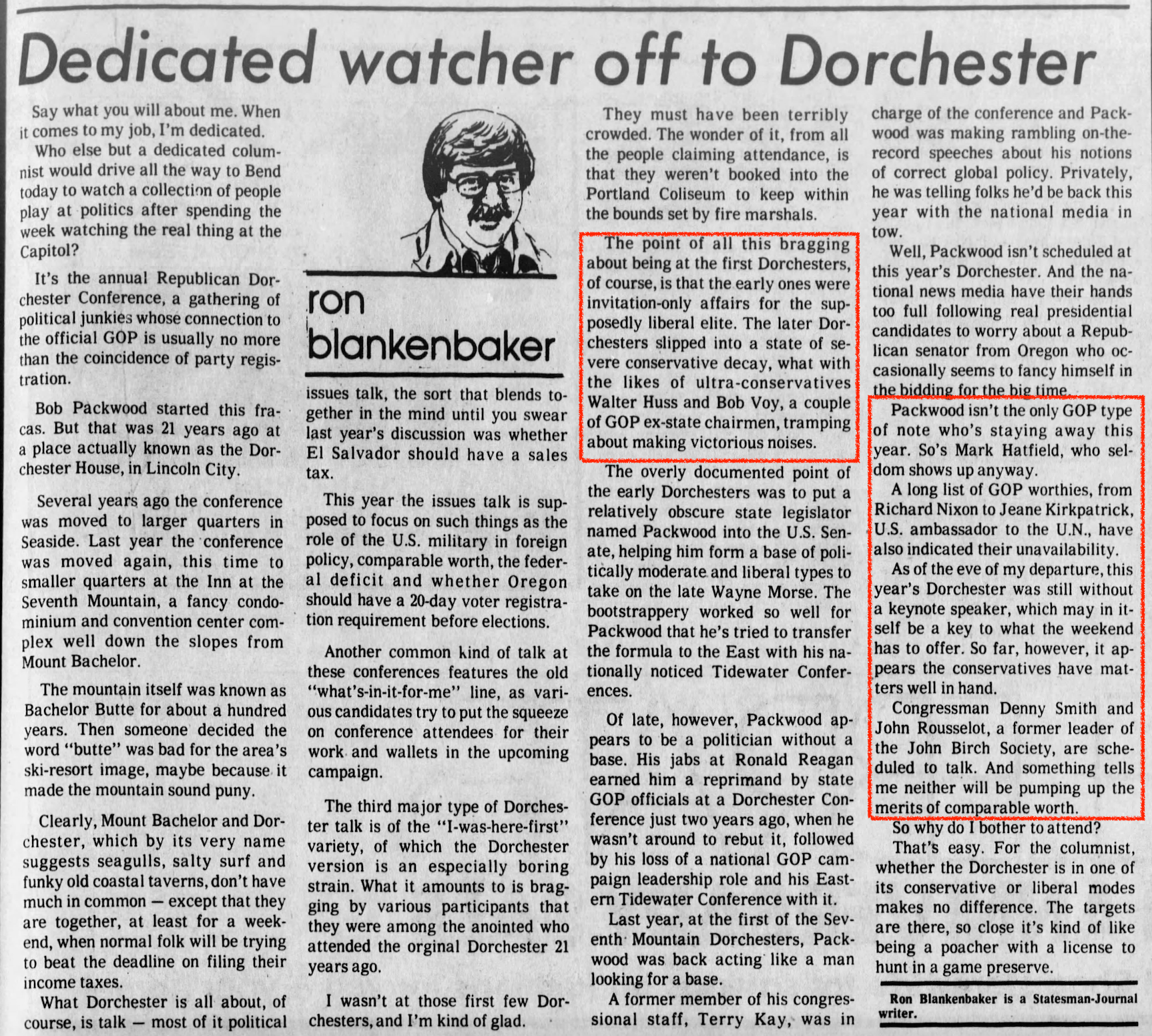
Five years later, the keynote speaker at Dorchester was John Rousselot, a long time John Birch Society leader who was running Reagan's re-election campaign in the West that year.
Not only was the whole "Dorchester Conference, haven for moderate Republicans" thing pretty much a mirage within a few years of its founding, it's also noteworthy that the person who funded Packwood's political activities as a "moderate" in the early 1960s was Ernie Swigert, Oregon's richest man and...wait for it...a founding member of the John Birch Society. That's right, Packwood's brand of "moderate Republicanism" was personally bankrolled by a founding member of the John Birch Society.
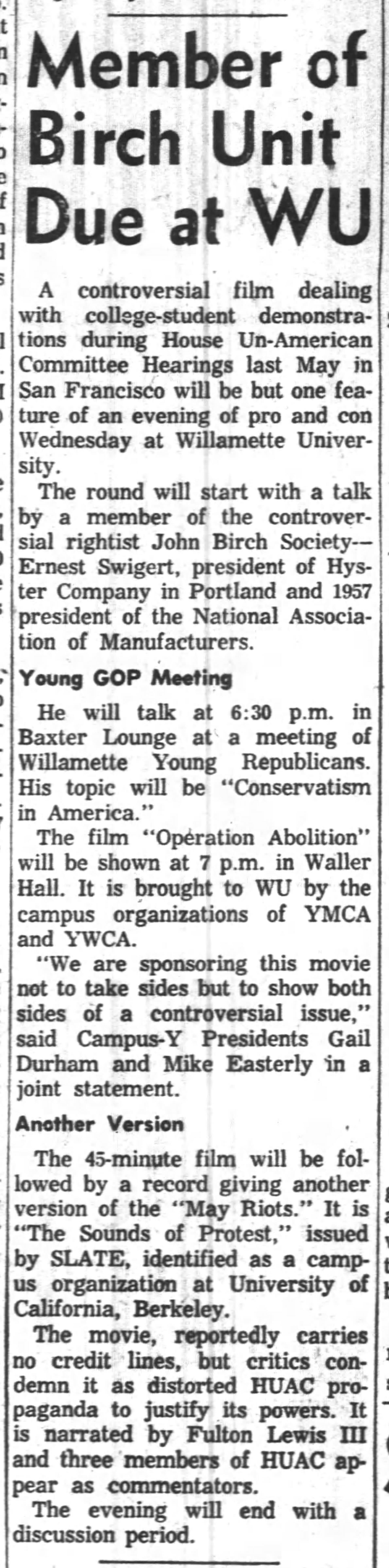
In his unpublished 2018 memoir Packwood acknowledges his connection to Swigert the Bircher, though he claims Swigert only joined the John Birch Society as a favor to his friend Robert Welch and wasn't a true believer. As Packwood frames it, Swigert was mostly a pragmatic business guy who liked Republican economic policies. Given that Swigert appeared publicly several times as a representative of the John Birch Society in 1961, three years after the organization's founding meeting in Indianapolis, I'd say that Swigert's connection to the Birchers seems to have been more authentic than Packwood let on. My sense is that Swigert, like many exorbitantly wealthy people in the 1960s, genuinely held the Bircher belief that "the internal communist enemy" posed a significant threat. But also, like many exorbitantly wealthy people in the 1960s, Swigert's primary concern was getting politicians elected who would pass tax and regulatory policies favorable to his economic self interest. In this sense, Packwood the social moderate but economic conservative fit that bill nicely. Once the John Birch Society became a topic of public ridicule in 1962, Swigert (like many people) likely recognized that publicly associating with them came with a serious reputational and electoral cost, and so he appears to have quietly cut ties.
Bob Packwood won five US Senate elections between 1968 and 1994, in part, because he was a moderate...but also because he was incredibly lucky
When 36 year old state legislator Bob Packwood decided to run for the US Senate in 1968, he had 7% name recognition across the state. Packwood's first bit of luck came when the very well-known and popular Republican Governor Tom McCall decided not to run in the primary. His second bit of luck came when no other prominent Republicans stepped up to challenge him in the primary--an arrangement which Packwood's Bircher patron Ernie Swigert, a longtime "kingmaker" in OR GOP politics, likely had something to do with. Packwood's 3rd bit of luck came when the vulnerable anti-Vietnam War Democratic incumbent, Wayne Morse, won his primary thanks to a spoiler campaign. His main pro-Vietnam War Democratic challenger Bob Duncan would have likely been a formidable foe for Packwood in the general election, but someone (perhaps Morse?) encouraged another pro-war Democrat, Phil McAlmond, to get into the primary and McAlmond drew enough votes away from Duncan to secure Morse's victory.
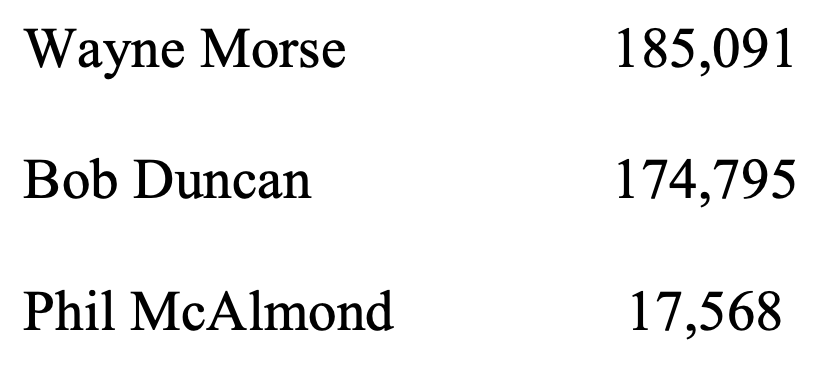
Packwood's last piece of luck came on election day when he narrowly defeated Morse by 3000 votes. Packwood ran an effective campaign and did very well in his one debate against Morse, so there's more to his first victory than just good fortune, but that played a significant role in it.
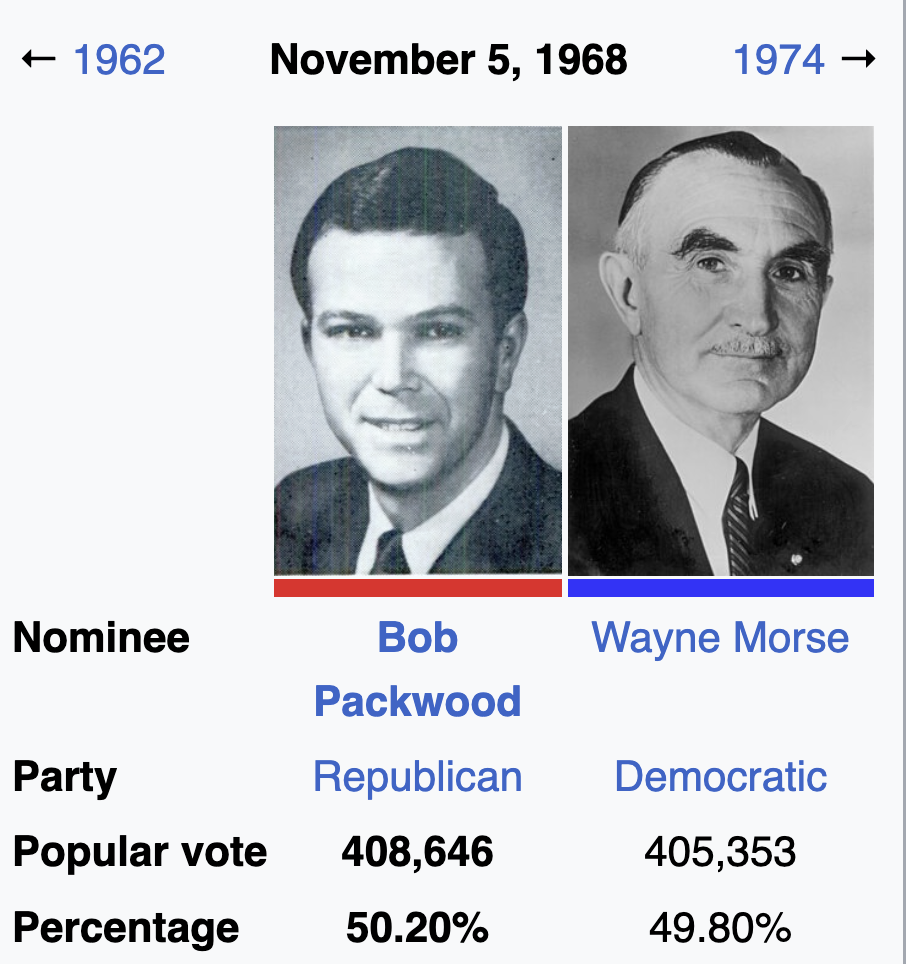
In 1974 Packwood lucked out again when his Democratic challenger, Wayne Morse, died on July 22. The Democratic Party replaced Morse with a less well-known candidate, and Packwood was able to parlay his name recognition and the advantage of incumbency into a fairly easy victory.
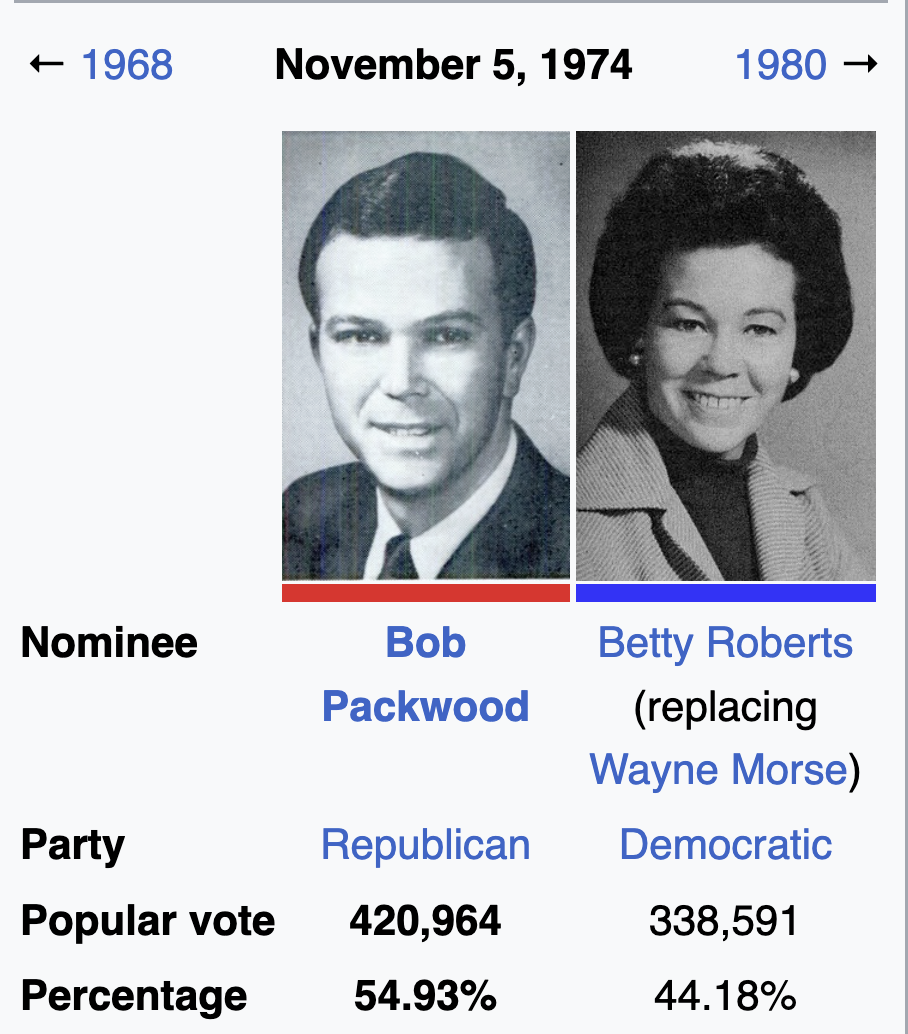
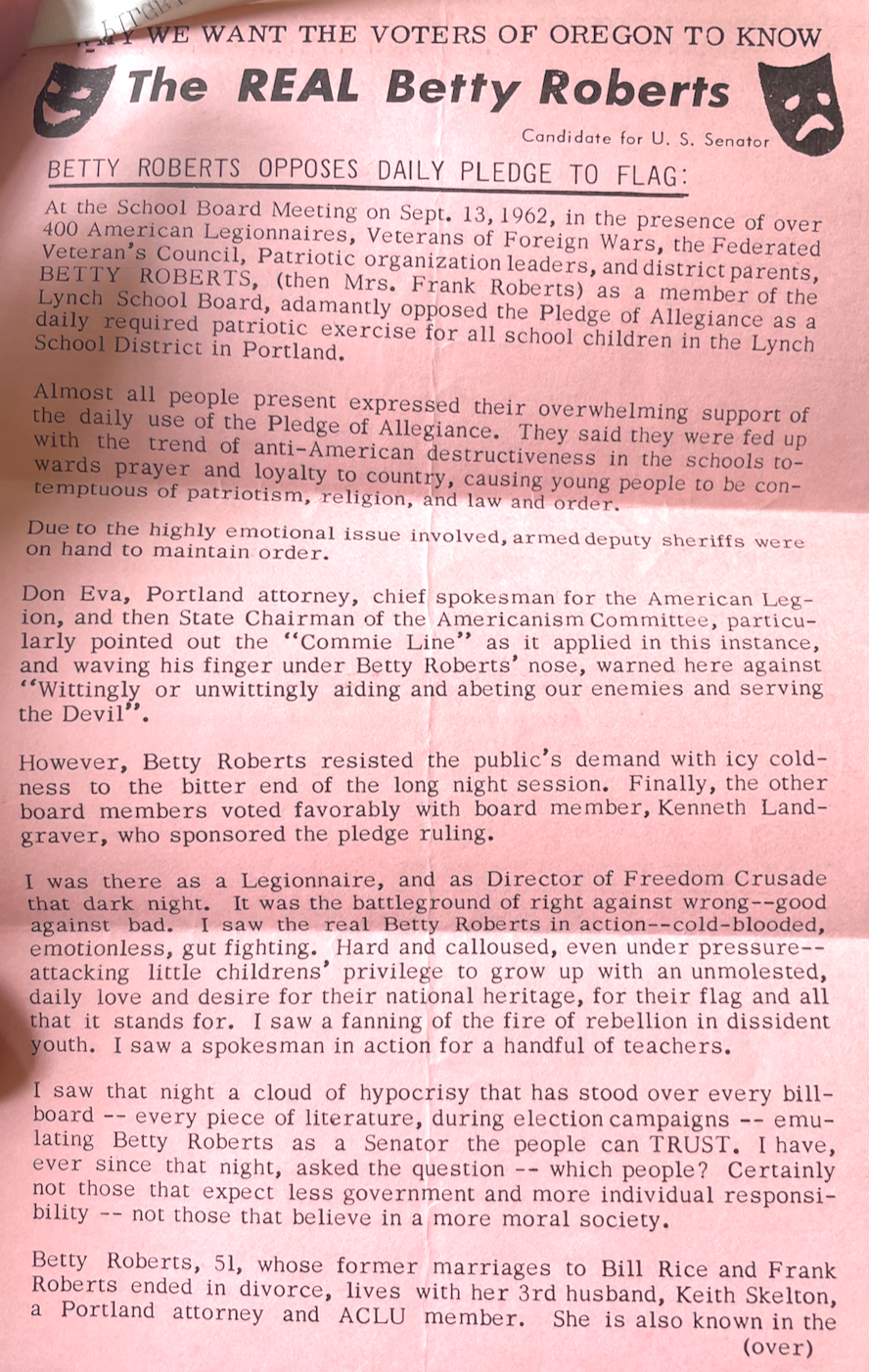
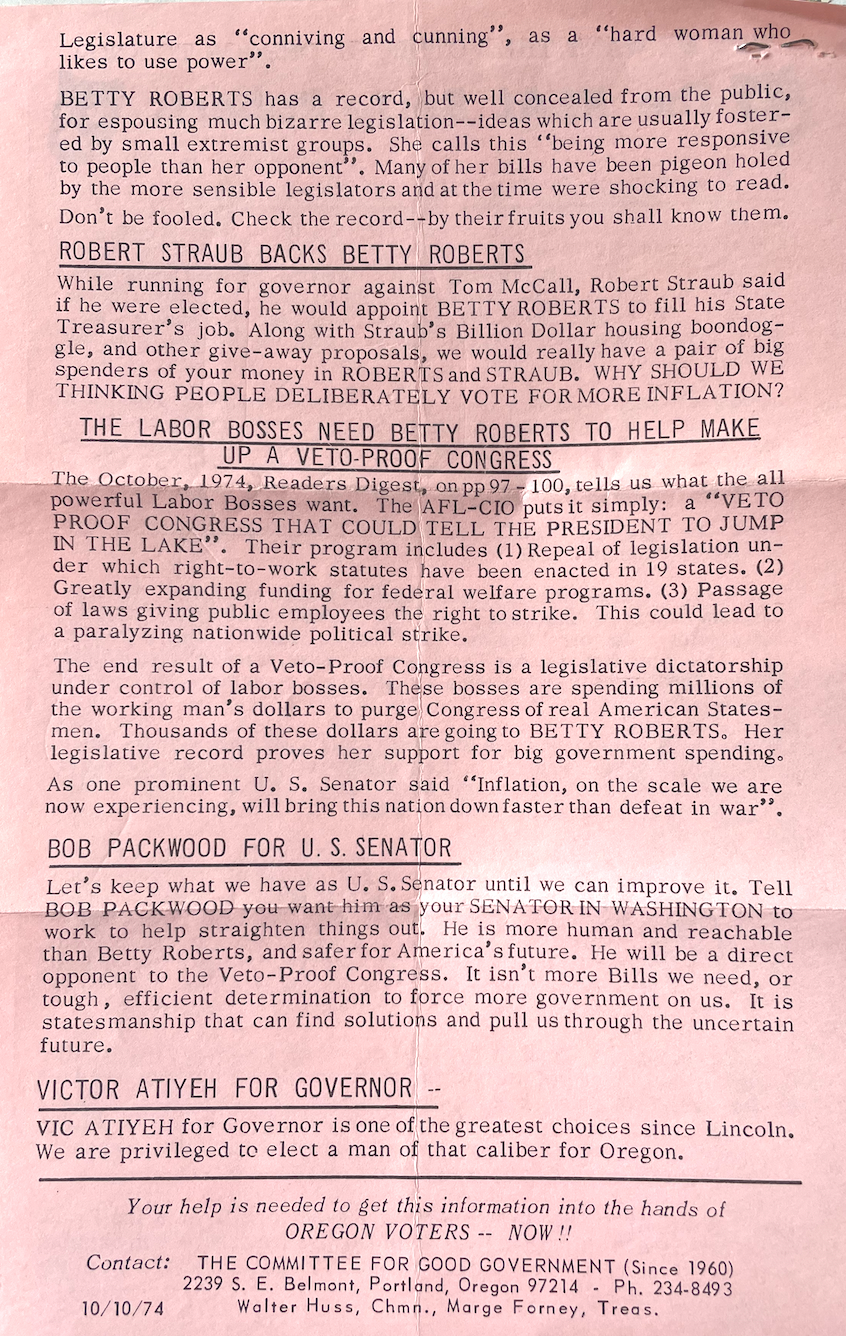
Interestingly, Oregon's leading far right activist and someone who was usually a thorn in Packwood's side, Walter Huss, used his clout in 1974 to encourage Oregonians to vote FOR Packwood the moderate Republican over Betty Roberts. As Huss saw it, Roberts was such a left-wing extremist (and a divorced hussy, to boot) that it was best for right wing Oregonians to "keep what we have as US Senator until we can improve on it."
In 1980 Huss's wife Rosalie decided that the best way to "improve" upon her US Senator was to challenge him in the Republican primary. When asked to identify where she differed with her fellow Republican Bob Packwood, Rosalie responded "I'm the opposite of him on just about everything." As with the right wing insurgency that sought to take over the Packwood-led Multnomah County GOP in 1962, Rosalie Huss's 1980 primary campaign against Packwood spoke not of a modest course correction for the OR GOP, but rather a revolutionary transformation.
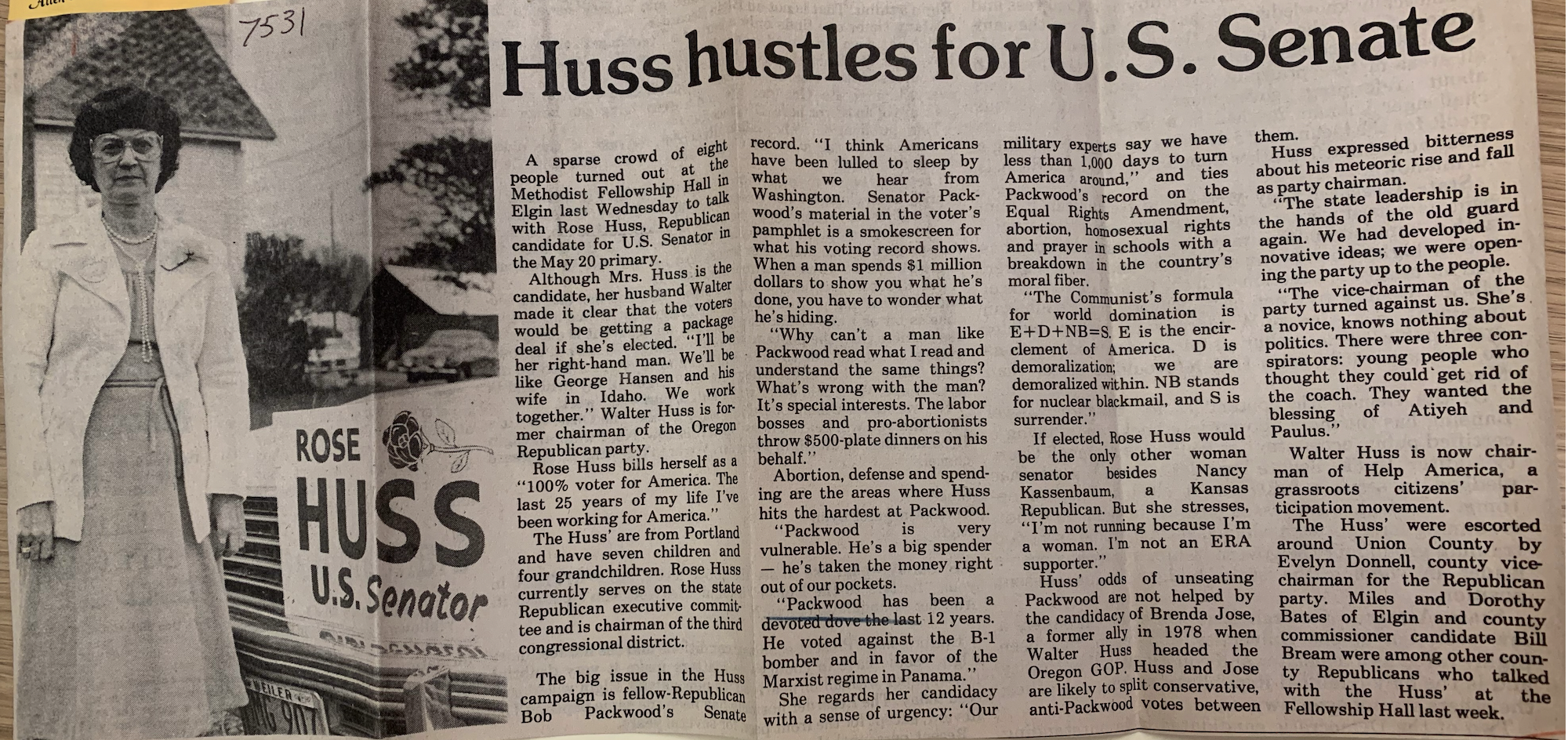
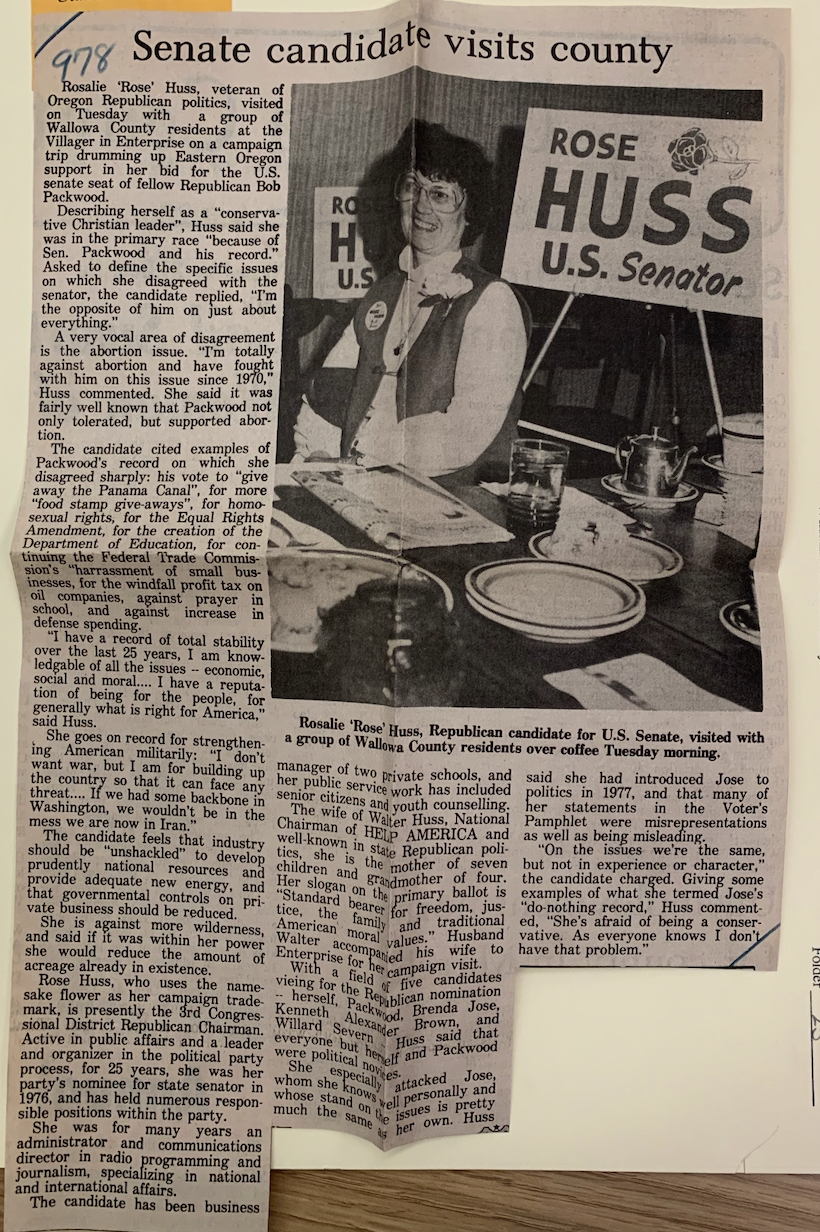
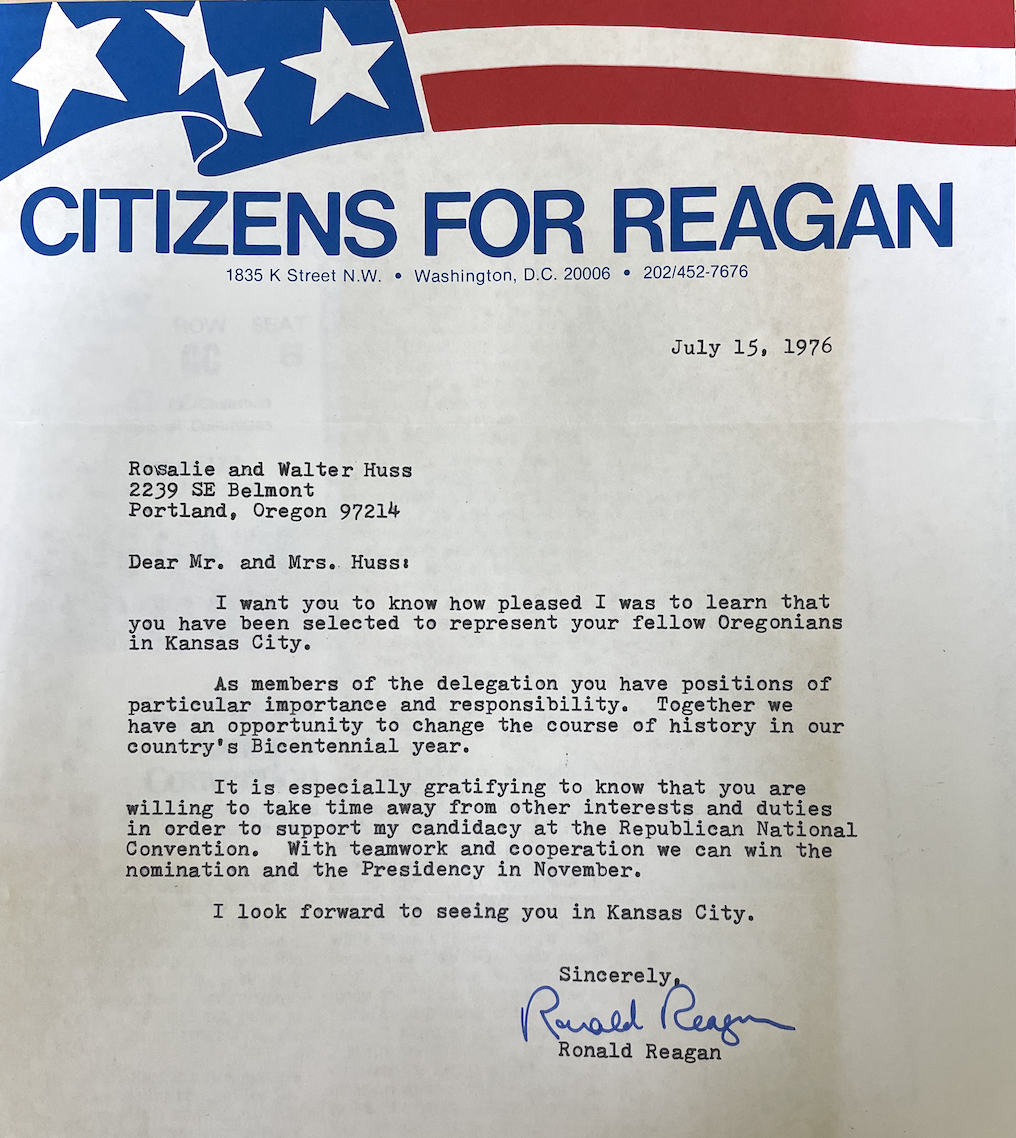
While the Husses were regarded as unwelcome outsiders by most establishment Oregon Republicans, it's not like they were strangers to organized Republican politics. In 1978 Walter Huss was elected chair of the Oregon Republican Party, and two years earlier Rosalie and Walter had attended the GOP convention in Kansas City as delegates for Reagan in his effort to unseat Gerald Ford as the nominee.
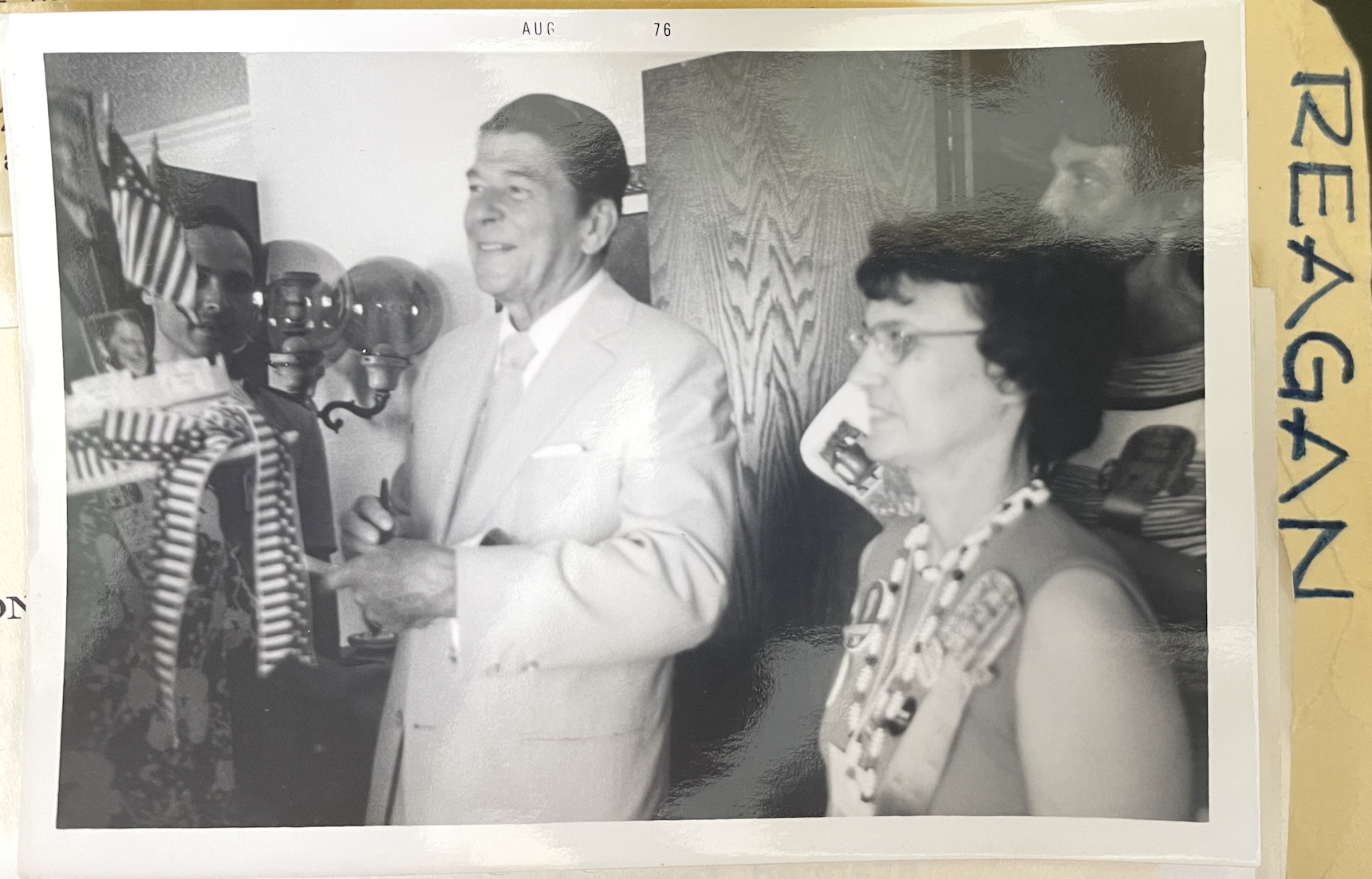
Packwood easily cruised to victory in the 1980 GOP primary, but there were ominous signs in terms of his support amongst the primary electorate. While no single candidate came close to defeating Packwood, the four candidates who collectively won 37% of the vote were all to Packwood's right, and significantly so. Rosalie Huss (7.5%), Walter's wife, we've met already.
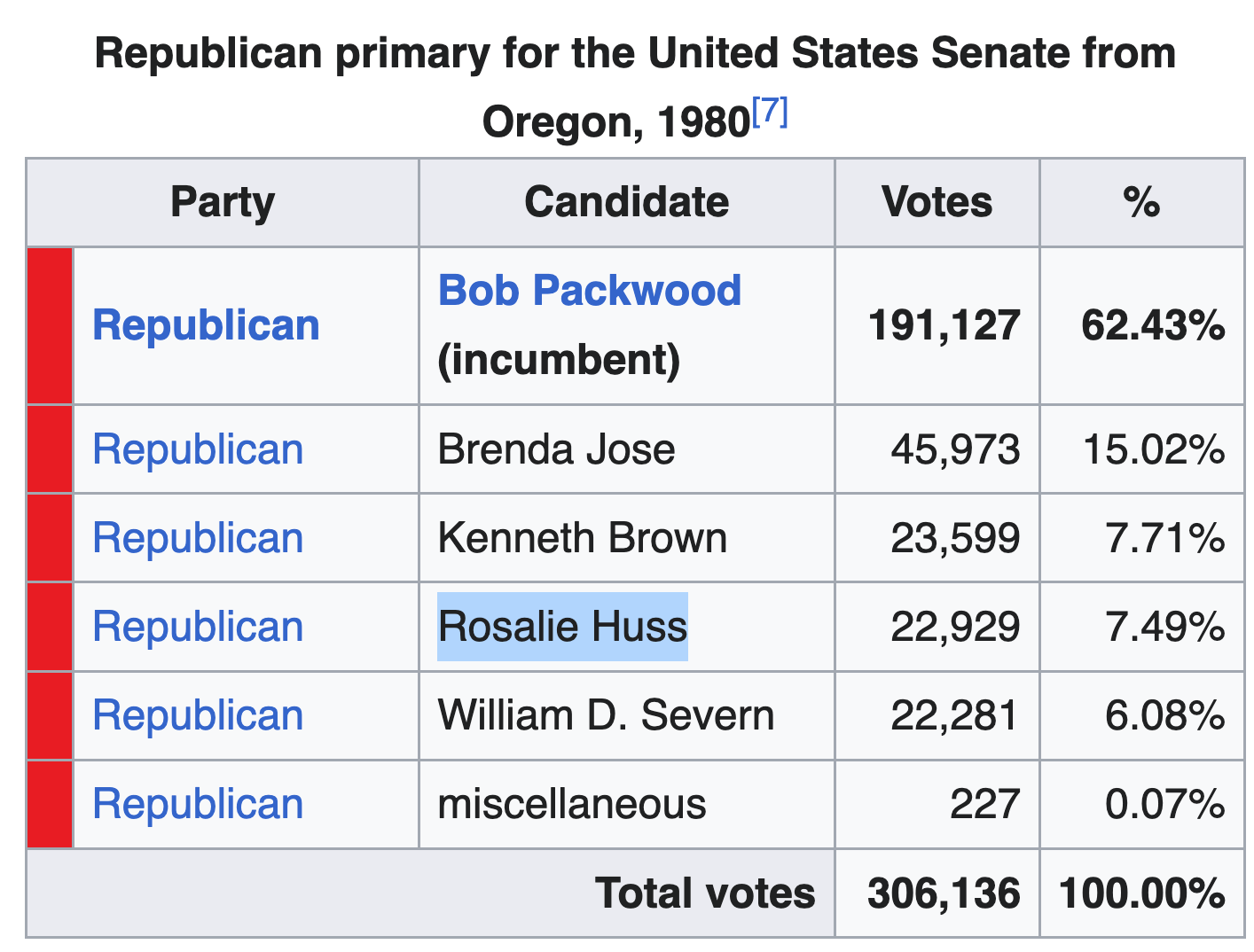
Brenda Jose (15%) was a fairly pablum, anti-abortion "Moral Majority" candidate who barely campaigned. Jose had once been a Christian conservative compatriot of the Husses and was part of the Christian right insurgency that put Walter into the chair's position in August of 1978. But she quickly soured on Walter (as most people who worked closely with him eventually did), and she provided one of the executive committee votes to oust him as chair in the spring of 1979. Needless to say, this earned Brenda Jose the eternal enmity of the Husses. When someone asked Rosalie what she thought of Brenda Jose, a candidate whose positions were virtually identical to hers, Rosalie dismissed her as a squish. "She's afraid of being a conservative. As everyone knows, I don't have that problem."
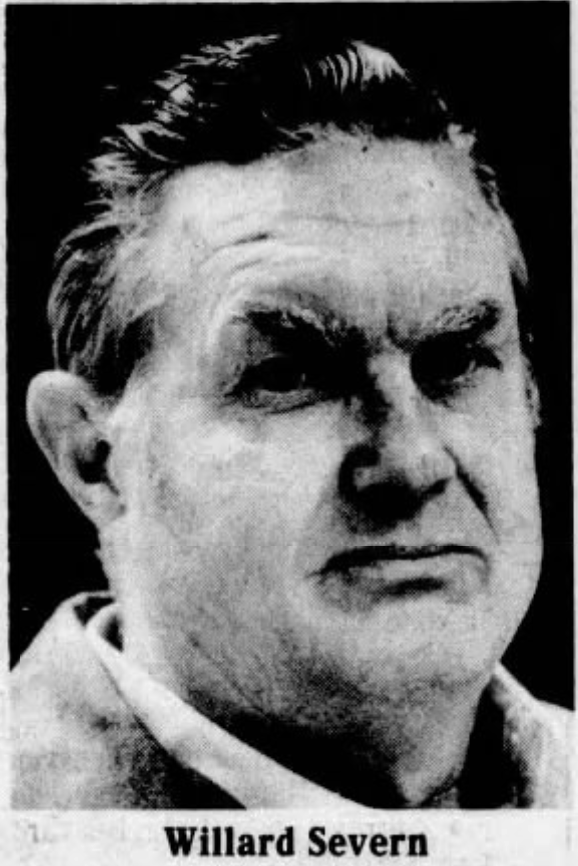
Willard Severn (6%) ran as a non-college-educated outsider anti-government populist who was long on complaints and short on solutions. His scowl pretty much says it all.
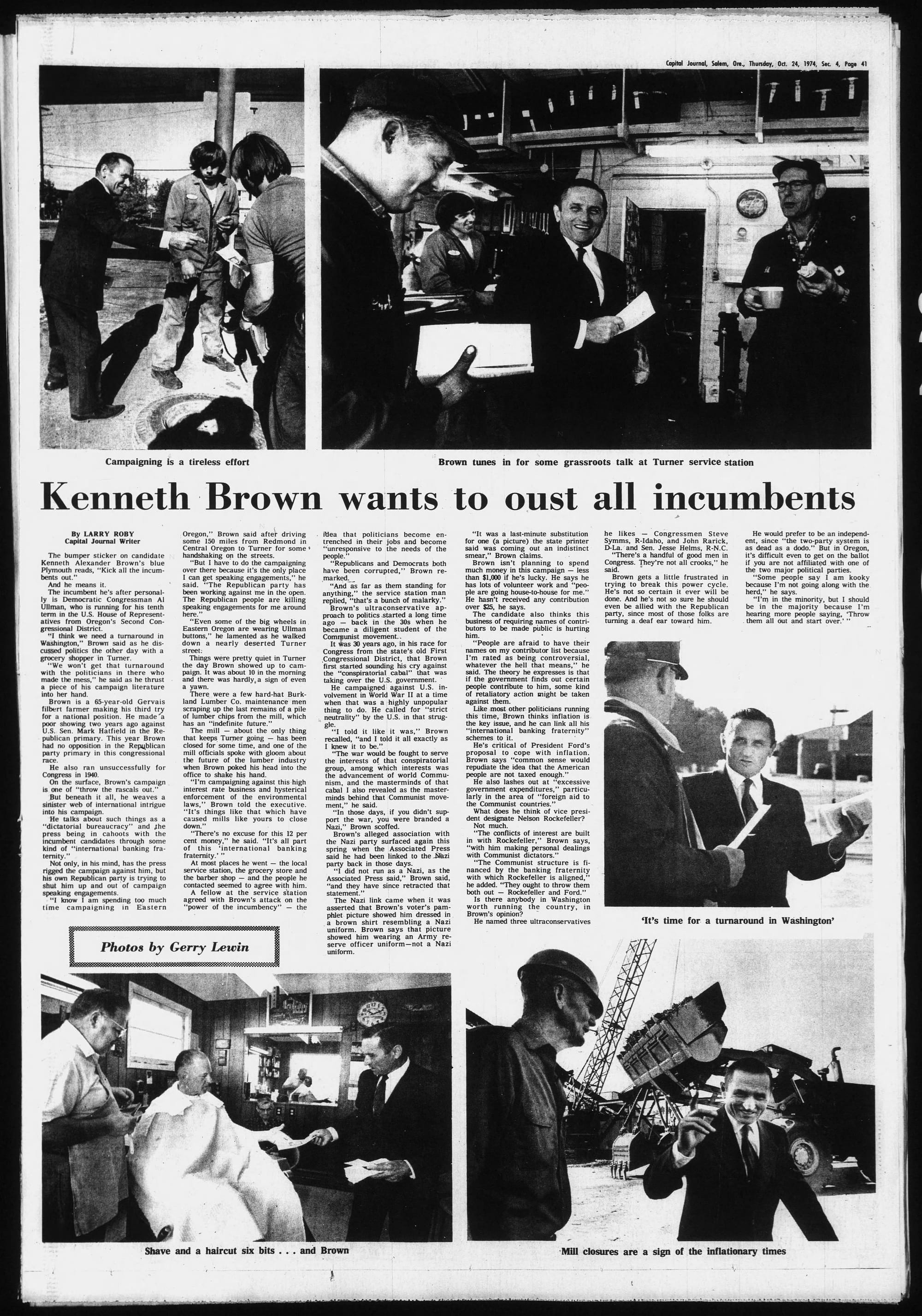
But the real star in this constellation of right wing populists who challenged Packwood from the right in 1980 was Kenneth Brown (7.7%) of Gervais. Brown had stood for office multiple times since 1940 when he first ran as an "America First," Jew-hating Silver Shirt. He also caused a memorable stir when he submitted a picture to the voters guide that featured himself wearing a Nazi-evoking Silver Shirt uniform.
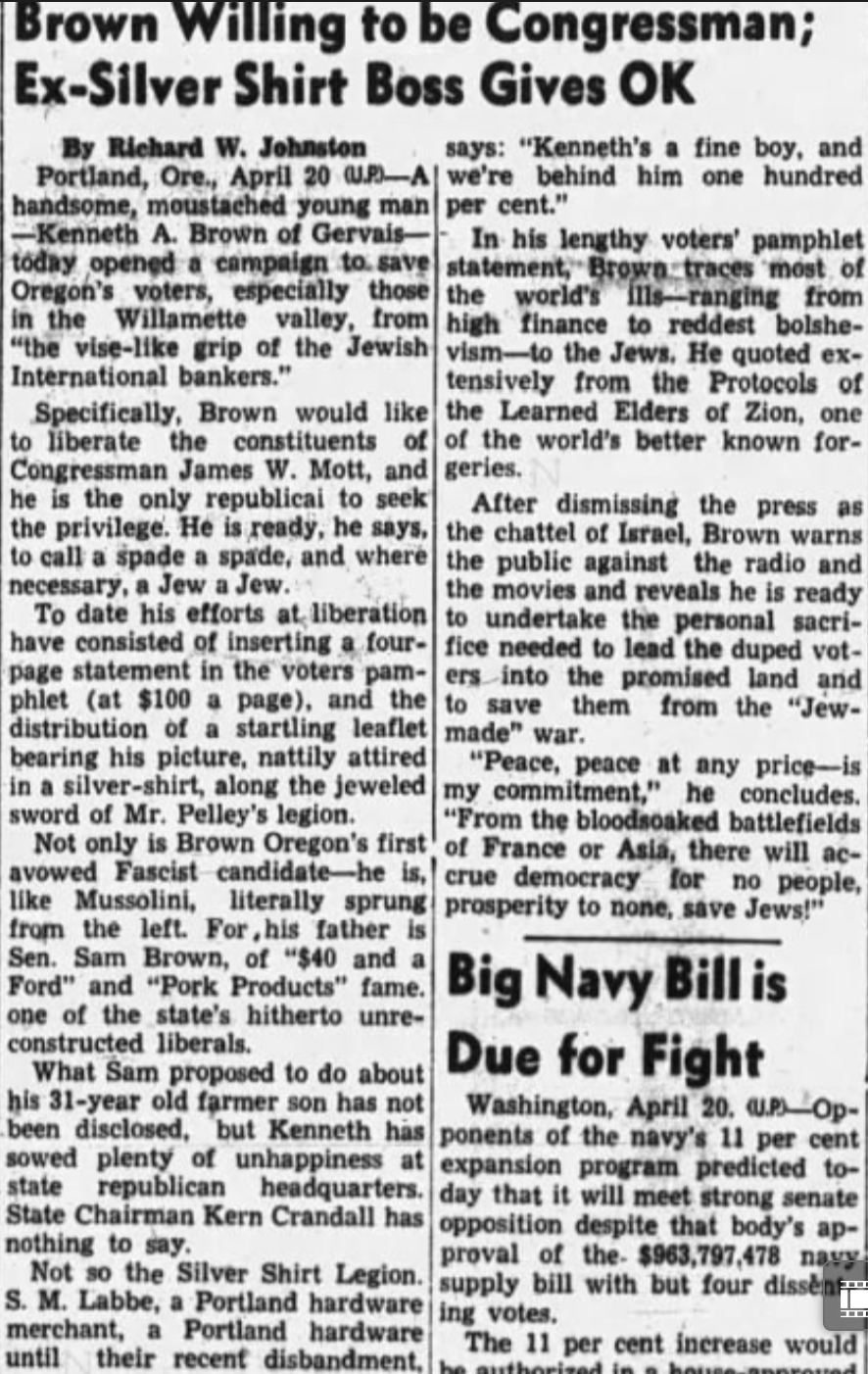
For the next 40 years Brown was a perennial far right candidate in Oregon primaries who never came close to winning but pressed a lot of flesh and got written up in the newspaper in ways that framed him as a bit of a kook, but also soft pedaled his fascistic politics.
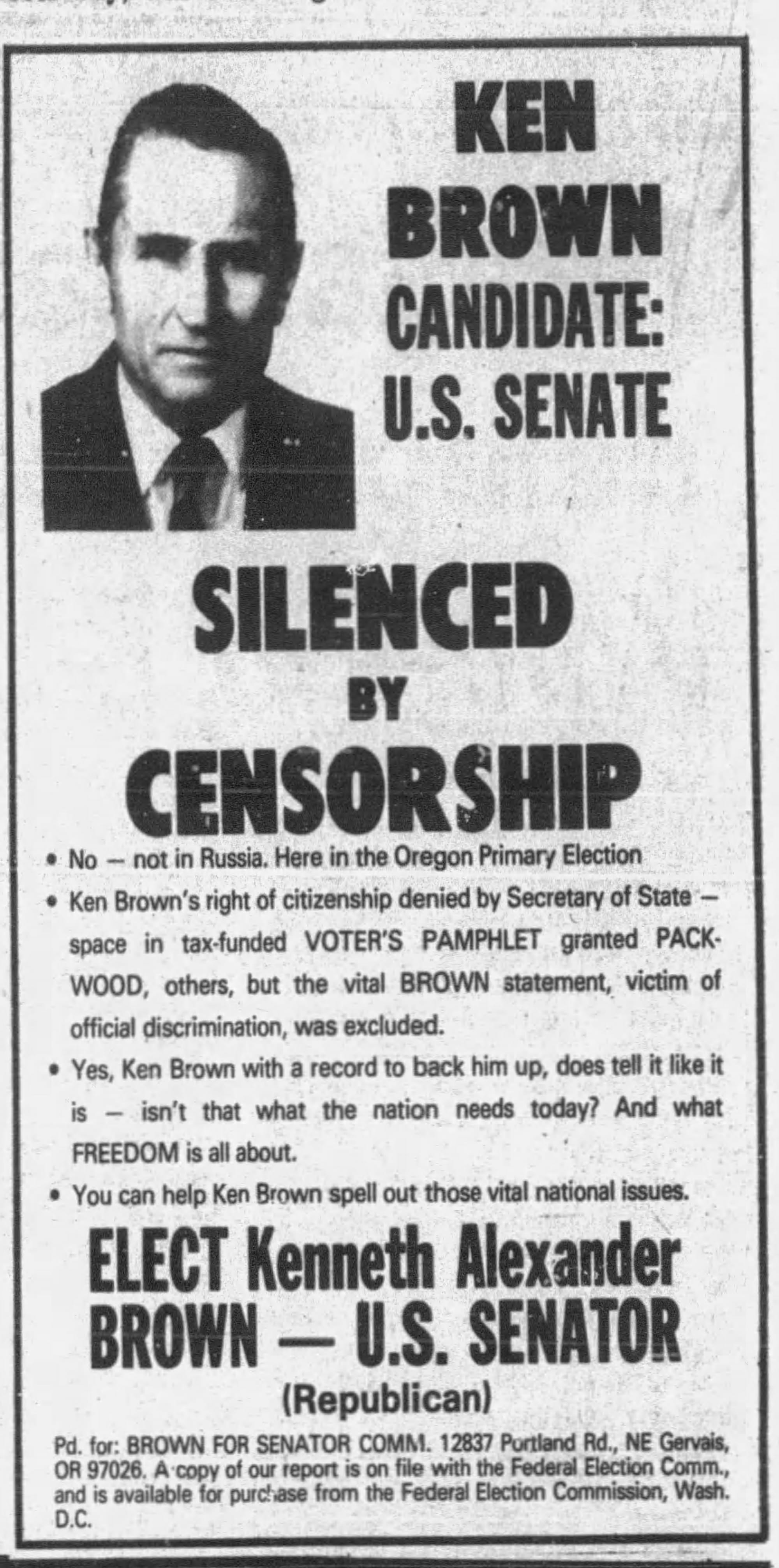
When Brown ran against Packwood in the 1980 GOP senatorial primary, a central plank of his message revolved around the claim that he was being silenced by a Jewish-controlled establishment...in this case, Republican Secretary of State Norma Paulus (who was not Jewish) who refused to print Brown's antisemitic candidate's statement in the 1980 voters guide.
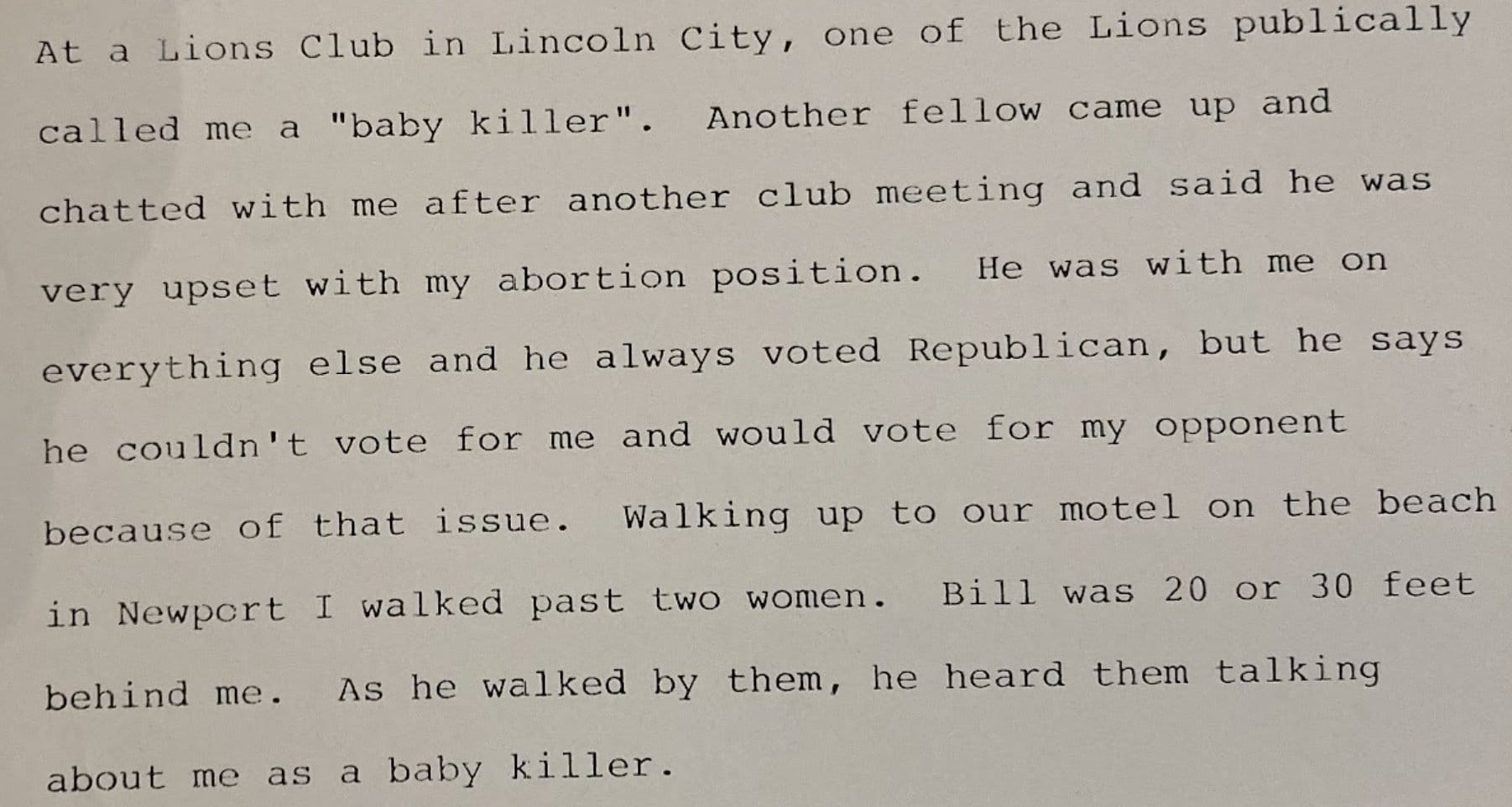
Even though Packwood won the 1980 primary handily, this memo to his staff shows his growing awareness of how angry and aggressive the grassroots anti-abortion advocates were getting in their personal interactions with him.
Packwood's greatest primary scare came in 1986. The right wing, anti-Packwood primary vote that was split in 1980 between Rosalie Huss, Brenda Jose, Willard Severn, and Kenneth Brown all consolidated behind a much more effective, Christian conservative candidate named Joe Lutz.
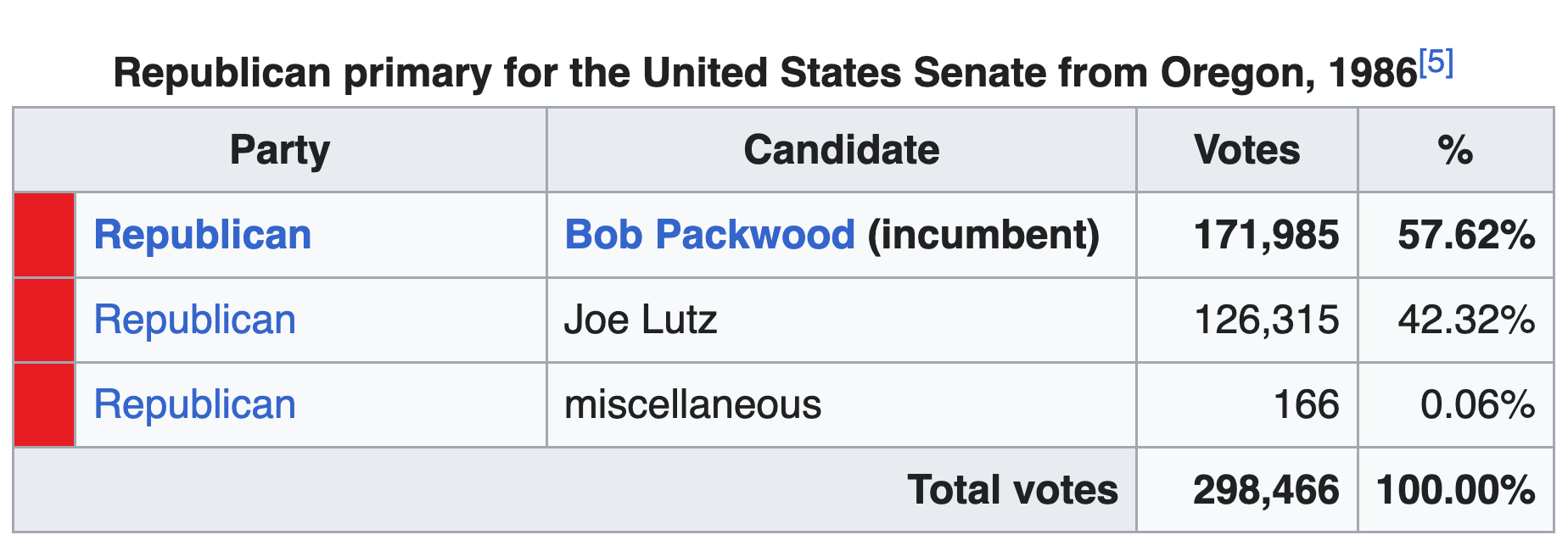
These days we're used to seeing the occasional incumbent Senator lose in a primary race, but in 1986 when 3-term master politician Bob Packwood lost 42% of the primary vote to a relatively unknown challenger, it was a real shot across the bow not just for Packwood, but for the entire Oregon Republican establishment.
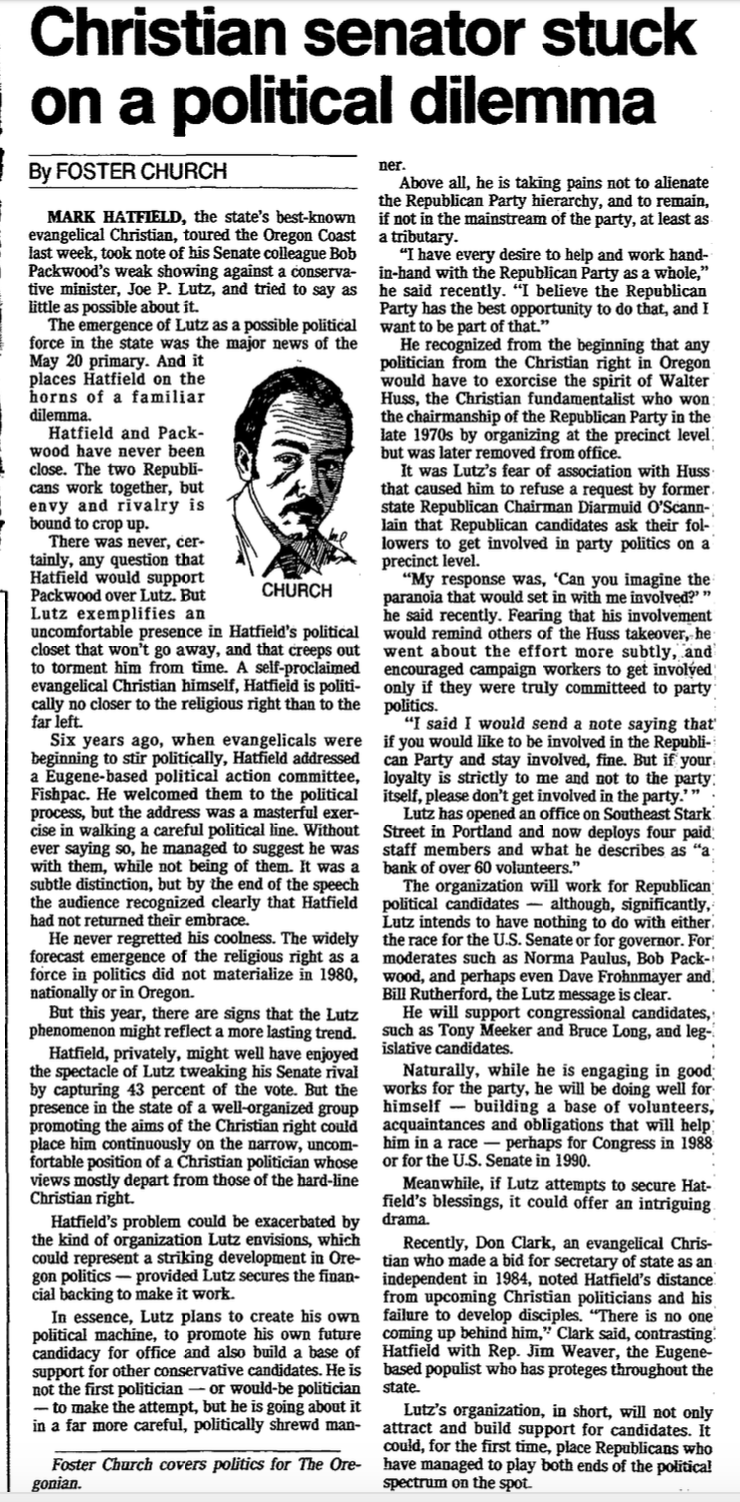
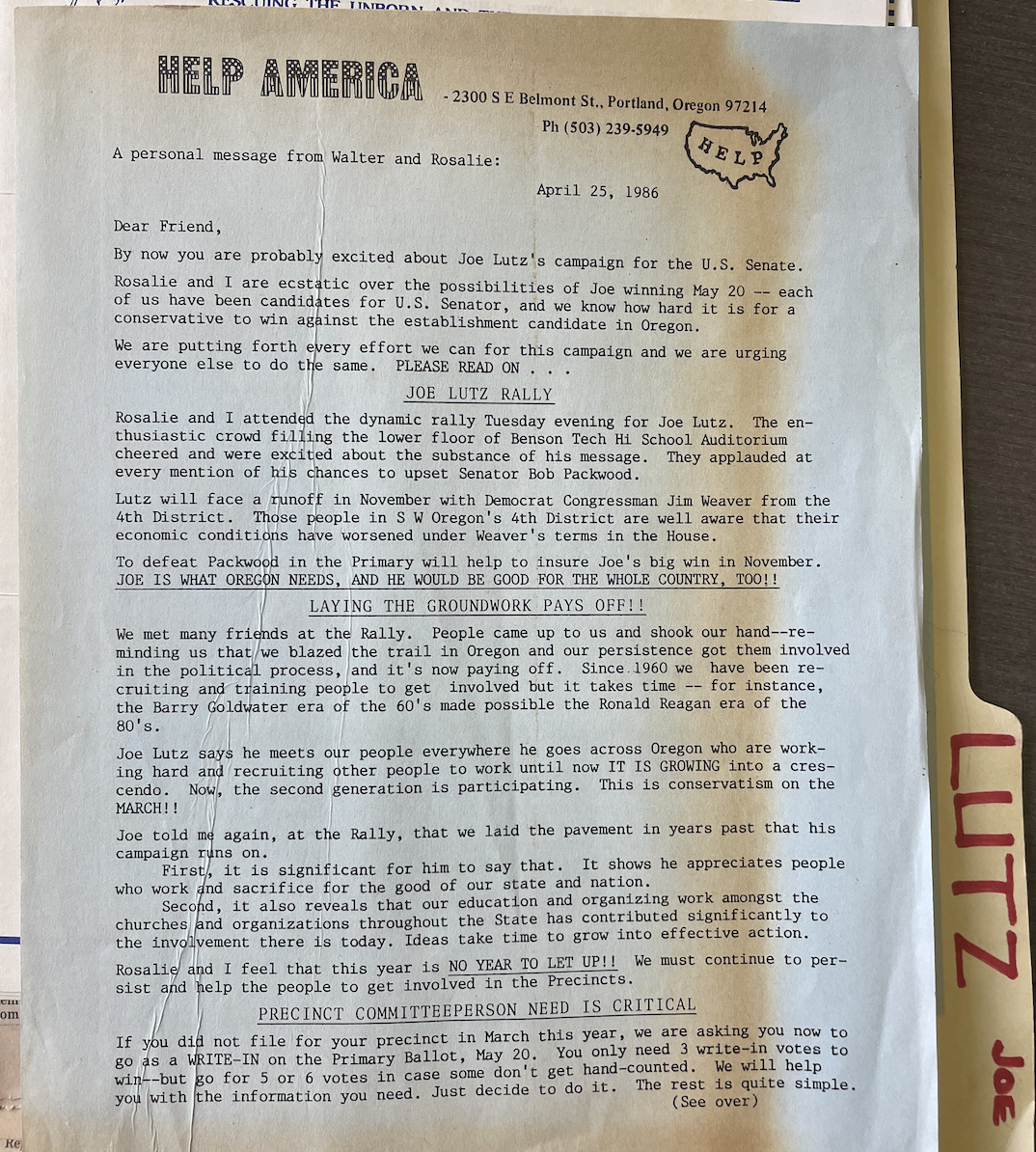
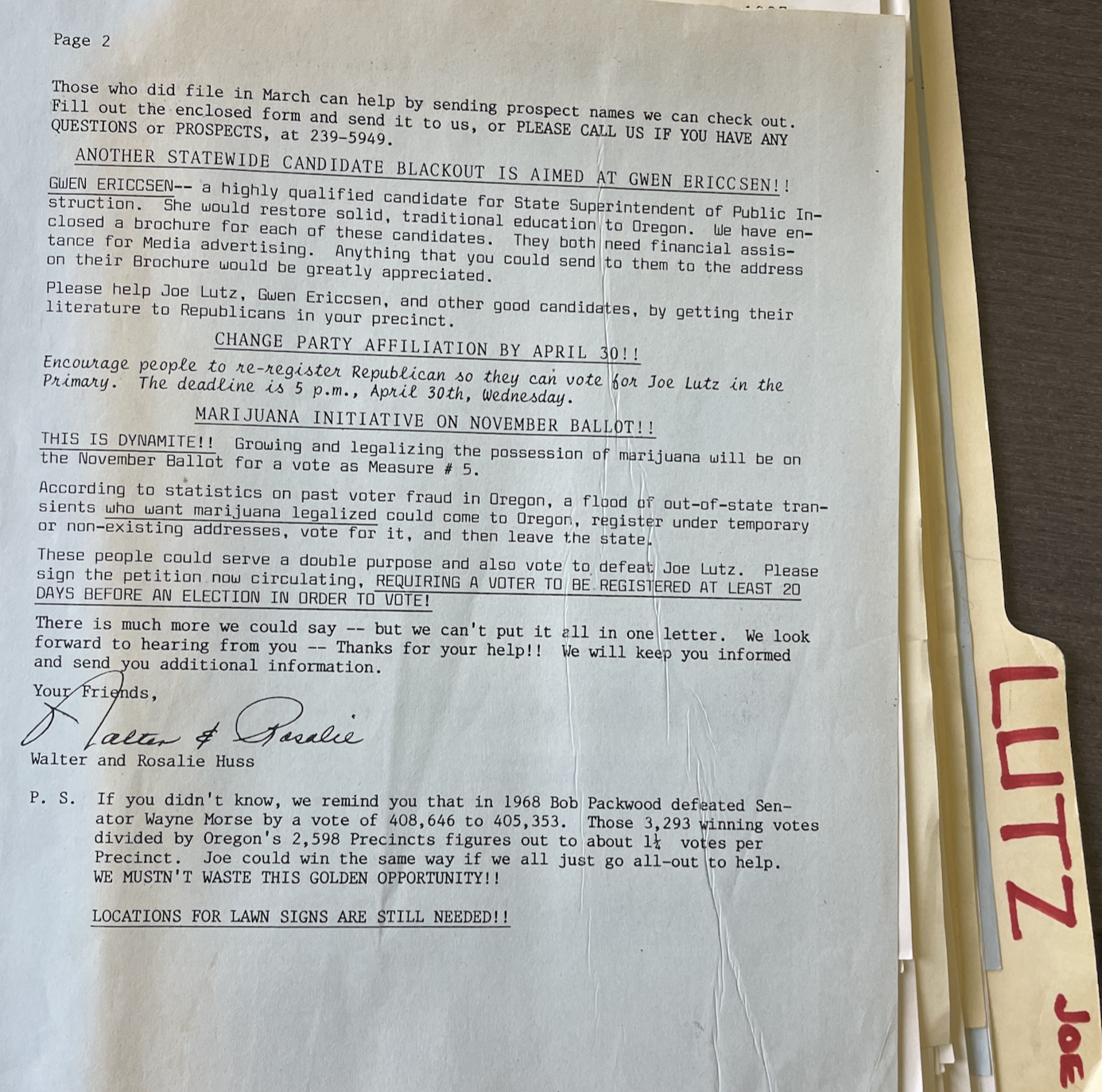
While Joe Lutz tried to keep Walter Huss at arms length during the primary for fear of being associated with Huss's disastrous tenure as party chair in 1978-9, Huss worked hard on Lutz's behalf and saw Lutz's candidacy as an extension of his and Rosalie's decades of organizing work.
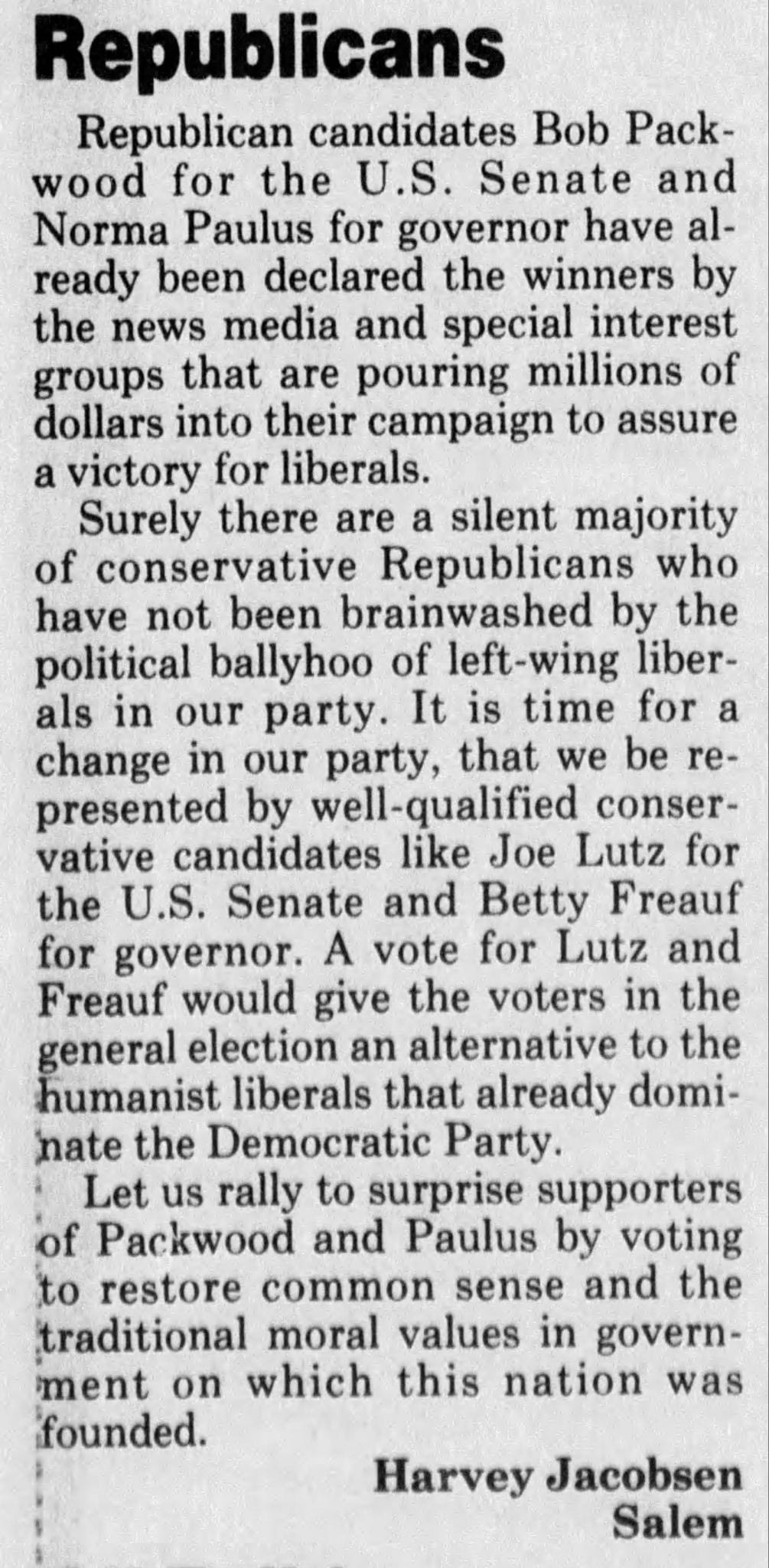
As the letter below from the 18 May 1986 Salem Statesman Journal shows, there was real grassroots energy around the idea of replacing establishment/moderate Republicans like Norma Paulus and Bob Packwood with "silent majority" candidates like Joe Lutz or Betty Freauf. [I don't have time to go in depth on Betty Freauf here, but suffice it to say that she was a close associate of Huss's who shared many of his ideas about the Jewish Conspiracy that moderate Republicans were supposedly complicit with. You can read her many public essays here, including this one explaining how Hitler was one of the good guys, like Jesus. The University of Oregon has acquired dozens of boxes of Freauf's papers, which will hopefully soon be available for researchers to use.]
Huss was being more than a little self-aggrandizing when he claimed that Joe Lutz in 1986 was carrying the political torch that Huss had first lit in 1960. That said, many of Lutz's most eager supporters had been brought into OR GOP politics by Huss's decades of organizational work across the state.
Packwood responded to Lutz's impressive showing in the primary by going on the offensive against his party's right wing, appropriately using the Dorchester Conference as the occasion for his remarks. "The Republican Party can again be the majority party in America if we understand that America wants diversity, not dictators."
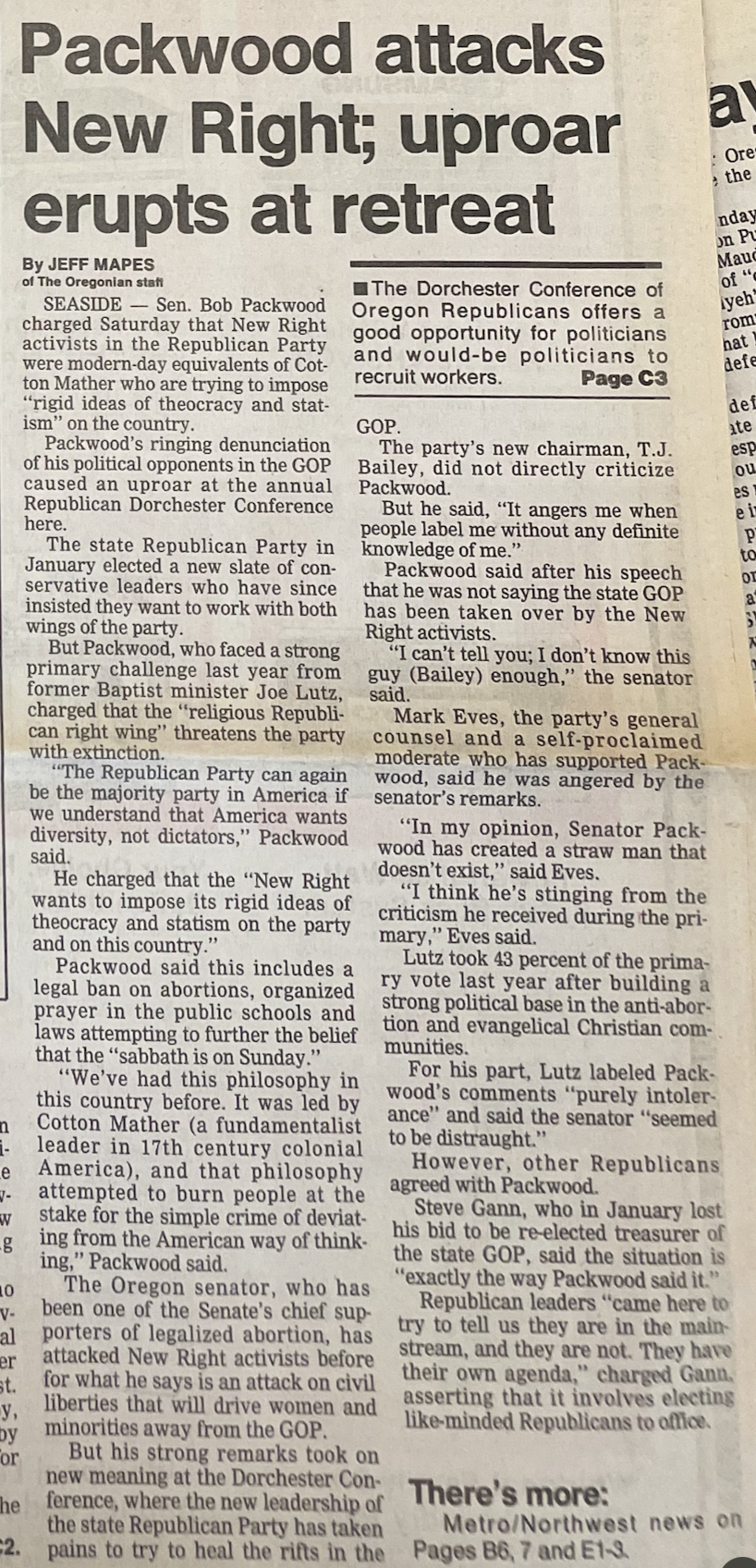
Just as Goldwater's defeat in 1964 inspired Packwood's public embrace of moderation, the GOP's weak performance in the 1986 midterms (they lost 8 seats in the Senate and 5 seats in the House, losing the House popular vote by 7.7%) lent weight to Packwood's claim that the rightward drift of the GOP was costing them votes, especially amongst "women and minorities." While a new generation of conservative Oregon Republicans like TJ Bailey were valiantly trying to hold the various elements of the party's coalition together, Packwood and his opponents on the far right hoped to permanently expel the other from the party's leadership ranks.
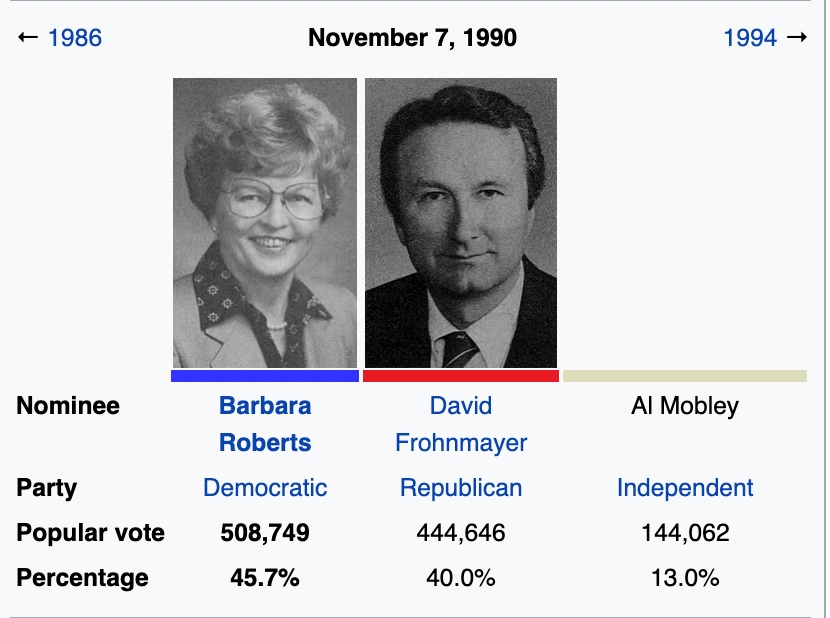
Given how close he'd come to being beaten in the 1986 primary, Packwood would have looked very nervously toward his 1992 race. The far right set an ominous precedent in the 1990 Oregon governor's race when Al Mobley, another anti-abortion "traditionalist" populist in the style of Joe Lutz, skipped the Republican primary and ran as a right wing spoiler in the general election. A September 1990 Oregonian poll had shown Dave Frohnmeyer, the popular moderate Republican candidate, with a comfortable 6 point lead over Democrat Barbara Roberts. When election day rolled around, however, Mobley won a surprising 13% of the vote, getting over 25% in many conservative counties, thereby drawing enough support away from the Republicans for the Democrat to win 46-40.
When faced with a choice between an "ultra-liberal" Democrat and a "liberal" Republican, a significant portion of the Oregon electorate instead chose to register a protest vote for someone they considered to be "a true conservative." Should the increasingly organized right in Oregon decide to run a spoiler in Packwood's 1992 race, it seemed likely that Packwood would suffer the same electoral fate as his fellow moderate Dave Frohnmeyer.
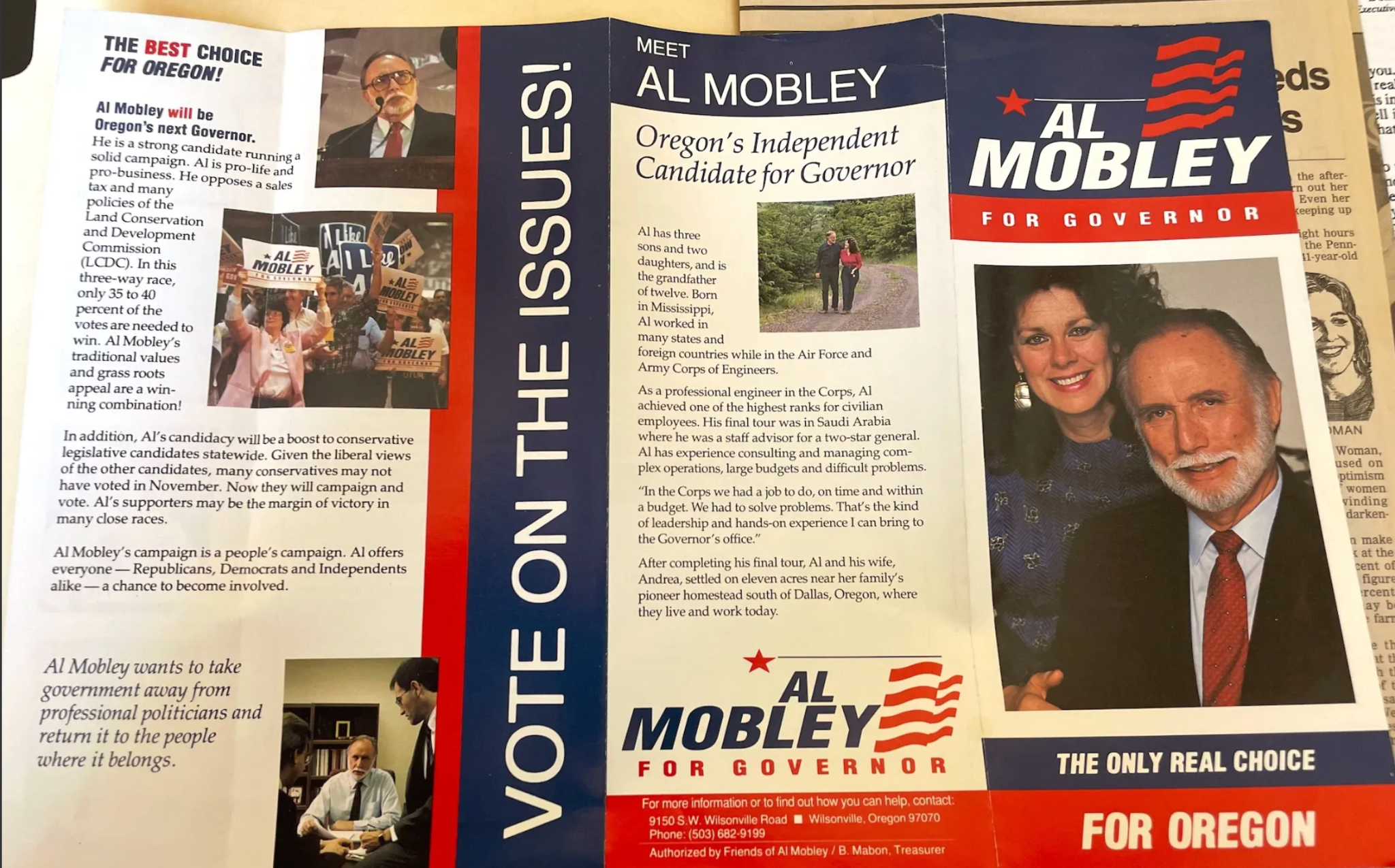
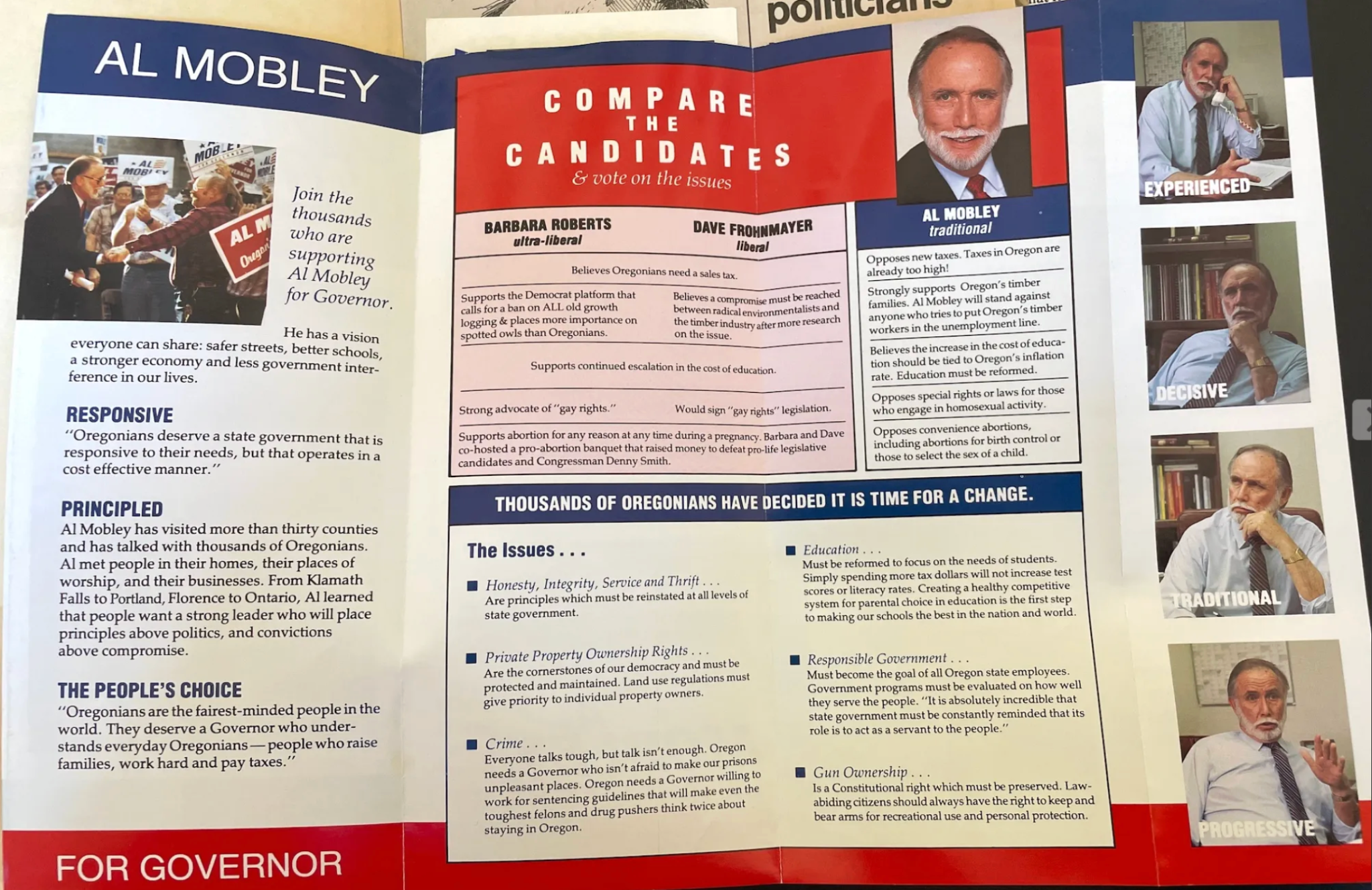
Having flexed their muscles with fairly strong showings by Lutz in 1986 and Mobley in 1990, it begs explanation why Oregon's right wingers decided NOT to primary their hated nemesis Bob Packwood in 1992 or run a spoiler candidate. It's possible that the leading right wing organization in the state, the anti-gay and anti-abortion Oregon Citizens Alliance (OCA), had decided to be good team players and work through institutional channels in the OR GOP to make change. It seems more likely, however, that Packwood acknowledged the power of the OCA and struck a deal for them to sit out his 1992 Senatorial race.
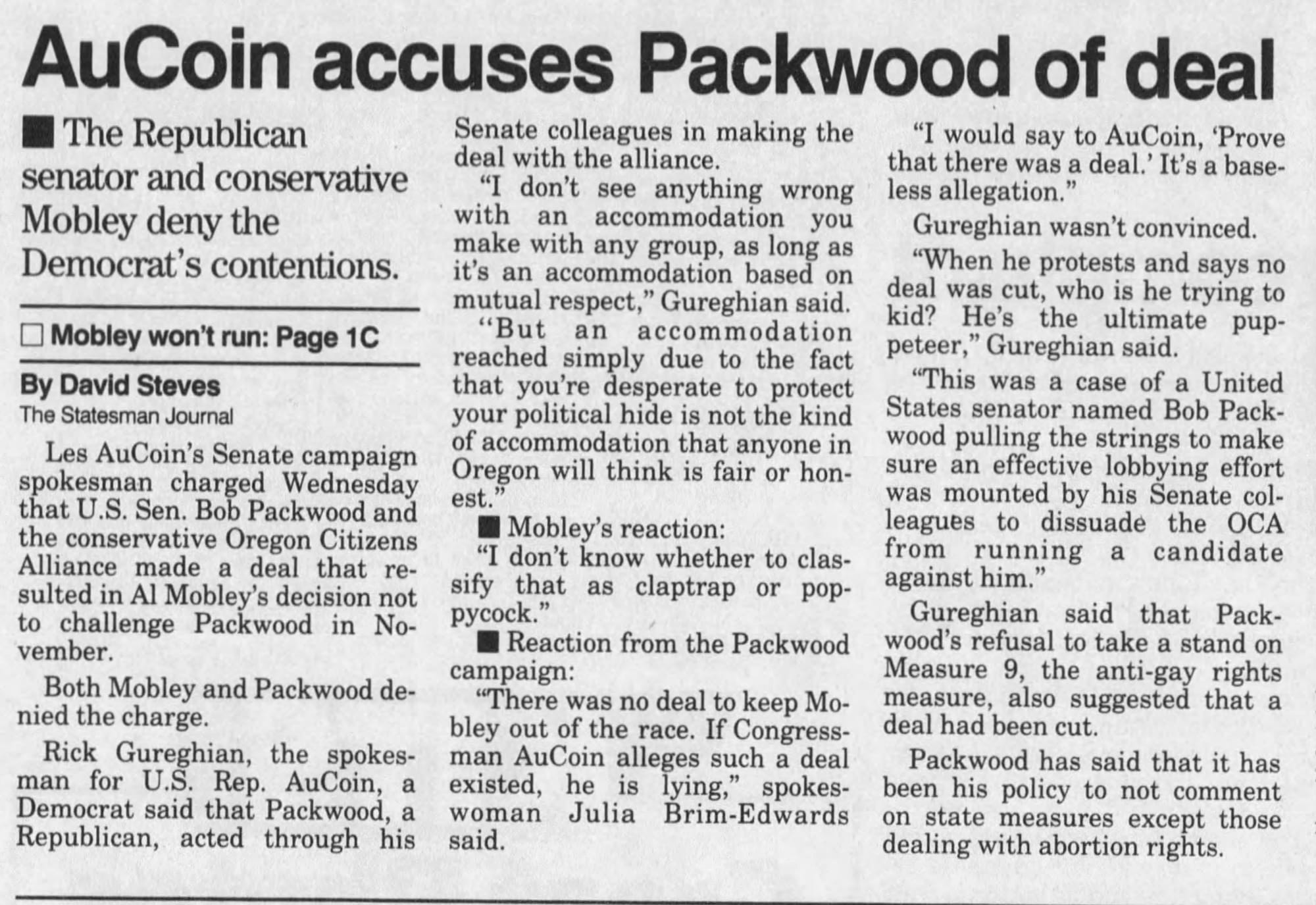
One rumored part of the Packwood/OCA deal, which some future historian will hopefully either confirm or deny when Packwood and John McCain's papers are available to researchers, was that Packwood promised OCA that he would secure them a high profile Republican speaker for a fundraising event. This perhaps explains why John McCain (who largely disagreed with the politics of the OCA) flew to Oregon in 1993 to headline an OCA fundraiser. The event sounds like it was quite a doozy, and I can only imagine the conversation McCain and Packwood probably had about it.
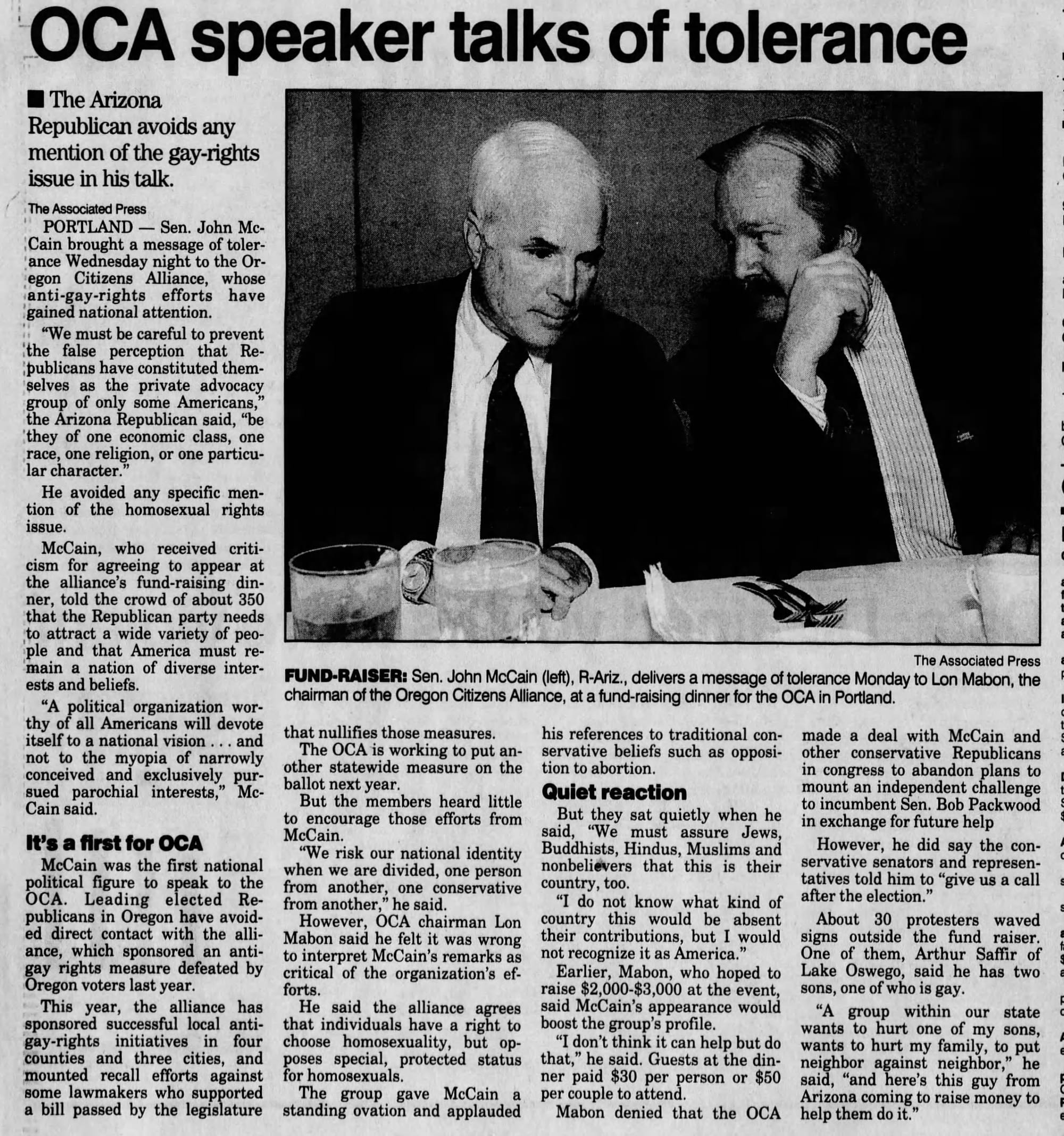
It speaks volumes about how the GOP got to where it is today that this 1993 audience of Oregon Republican activists sat on their hands when John McCain delivered this applause line: "We must assure Jews, Buddhists, Hindus Muslims and nonbelievers that this is their country too. I do not know what kind of country this would be absent their contributions, but I would not recognize it as America." To a great extent, one's response to that pablum statement about religious pluralism by McCain marks a key dividing line between the pre- and post-MAGA GOP. There were certainly plenty of Christian nationalists like Walter Huss and the OCA who were involved in OR GOP politics for decades before Trump rode down that escalator, but until Trump's ascendancy, such people took a backseat to establishment types like Packwood, McCain, Hatfield, and Romney who were comfortable living in a small-l "liberal" society defined by its religious and cultural diversity.
There's another notable episode, foreshadowing our present moment, that occurred at that 1993 McCain/OCA event. The evening opened with Marylin Shannon, the vice-chairman of the OR GOP, offering praise and a prayer for a Grants Pass anti-abortion activist named Shelley Shannon (no relation). Two weeks earlier, Shelley Shannon, a member of a Christian terrorist group called "The Army of God," had attempted to murder abortion provider George Tiller.
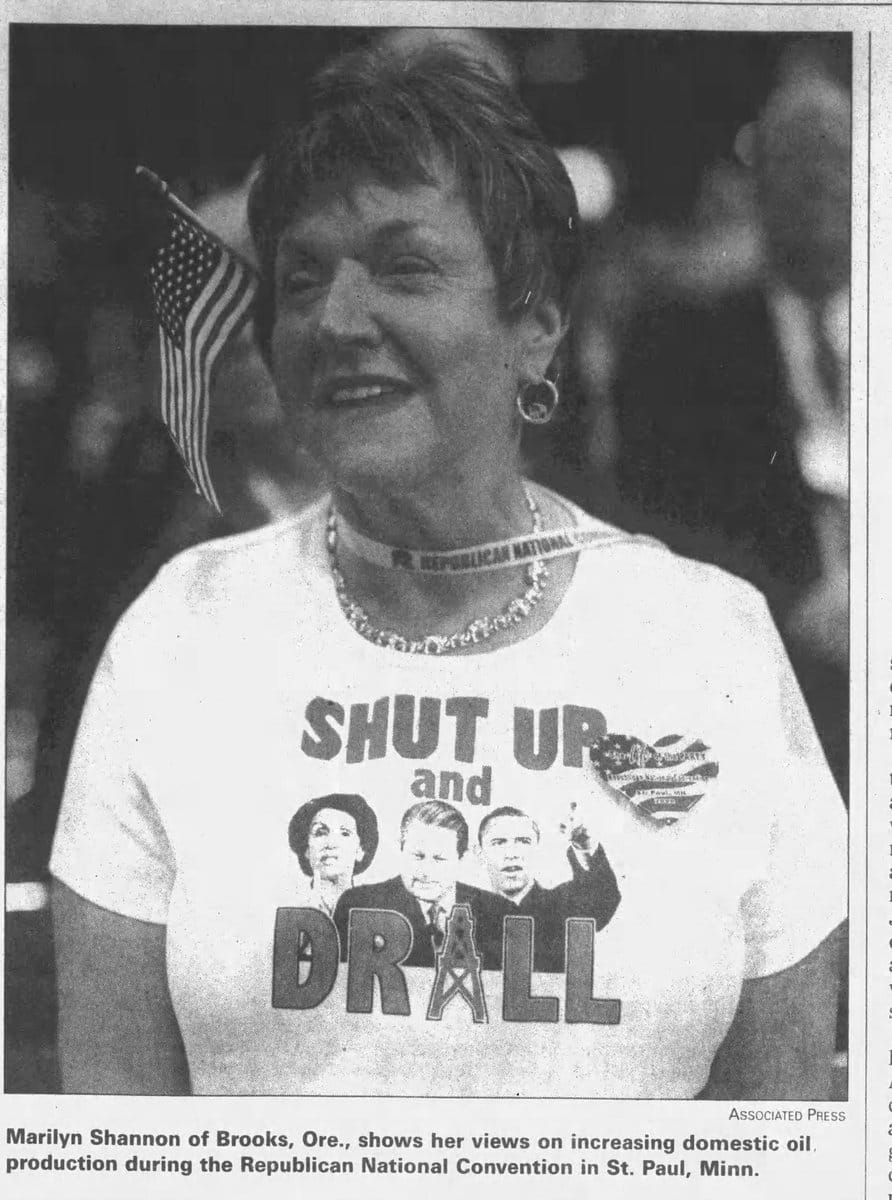
When McCain was the GOP nominee for President in 2008 (with Marylin Shannon in attendance at the 2008 RNC as a McCain delegate), this episode from 15 years earlier briefly resurfaced. Given Sarah Palin's complaints about Barack Obama "pal-ing around with terrorists," McCain's decision to sit silently next to Marilyn Shannon in 1993 as she praised a murderous terrorist seemed more than a little hypocritical.
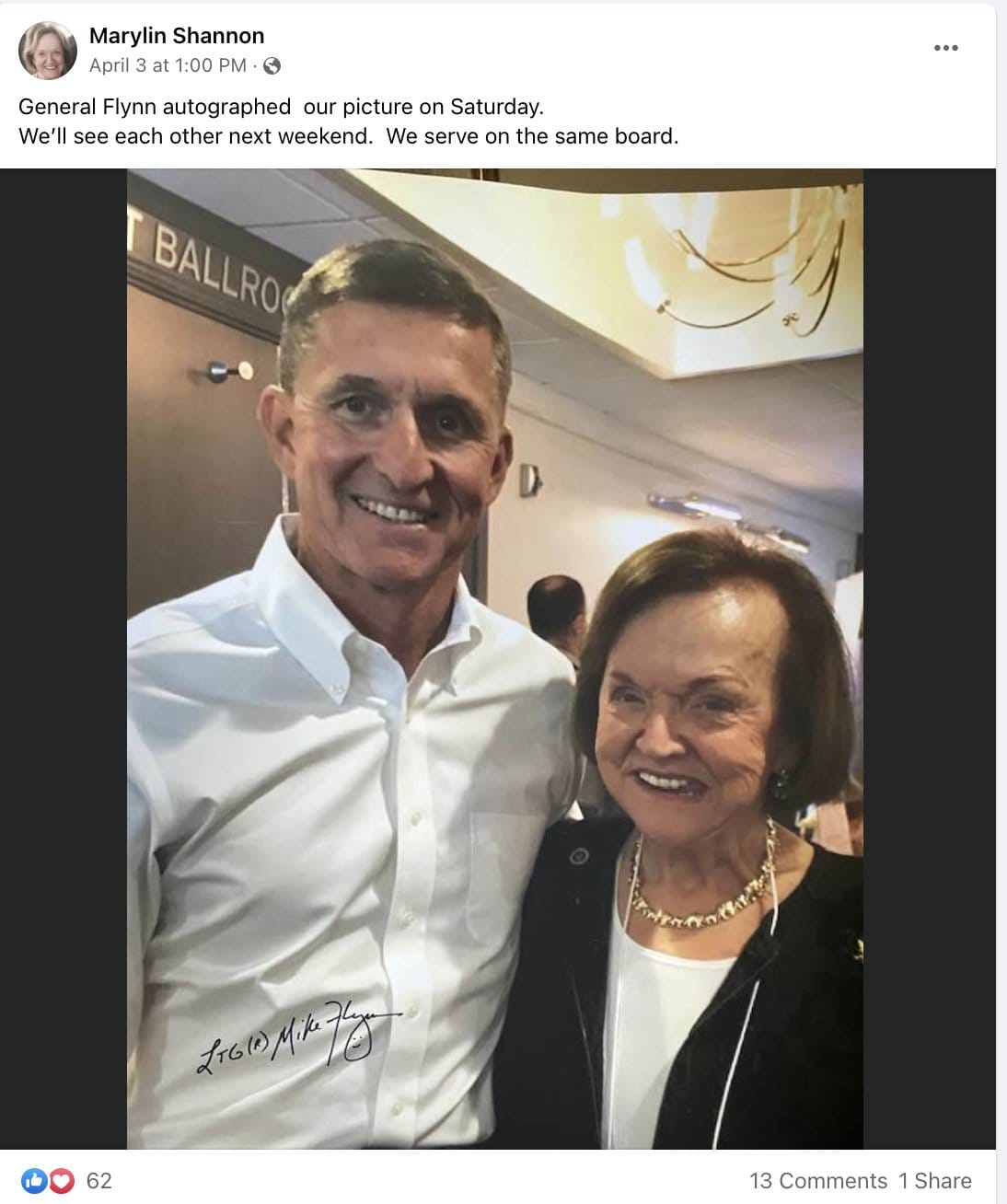
While once prominent Republicans like John McCain and Bob Packwood are now dismissed as pathetic RINO's by most people in Trump's GOP, Marylin Shannon, once considered a right wing fringe figure in the OR GOP, now feels quite at home in what the Republican Party has become. When Mike Flynn's Christian nationalist and election denialist Reawaken America tour rolled through Salem in 2022, for example, Marylin attended a VIP event at his hotel in Salem.
In 1993 Packwood likely thought there was no harm in placating murder-condoning, theocratic, anti-gay bigots like Marylin Shannon because, just as he likely thought in 1962 about Walter Huss and his crew, such "kooks" could never displace reasonable and electorally successful moderates like him in the hearts of Oregon's Republican voters. Alas.
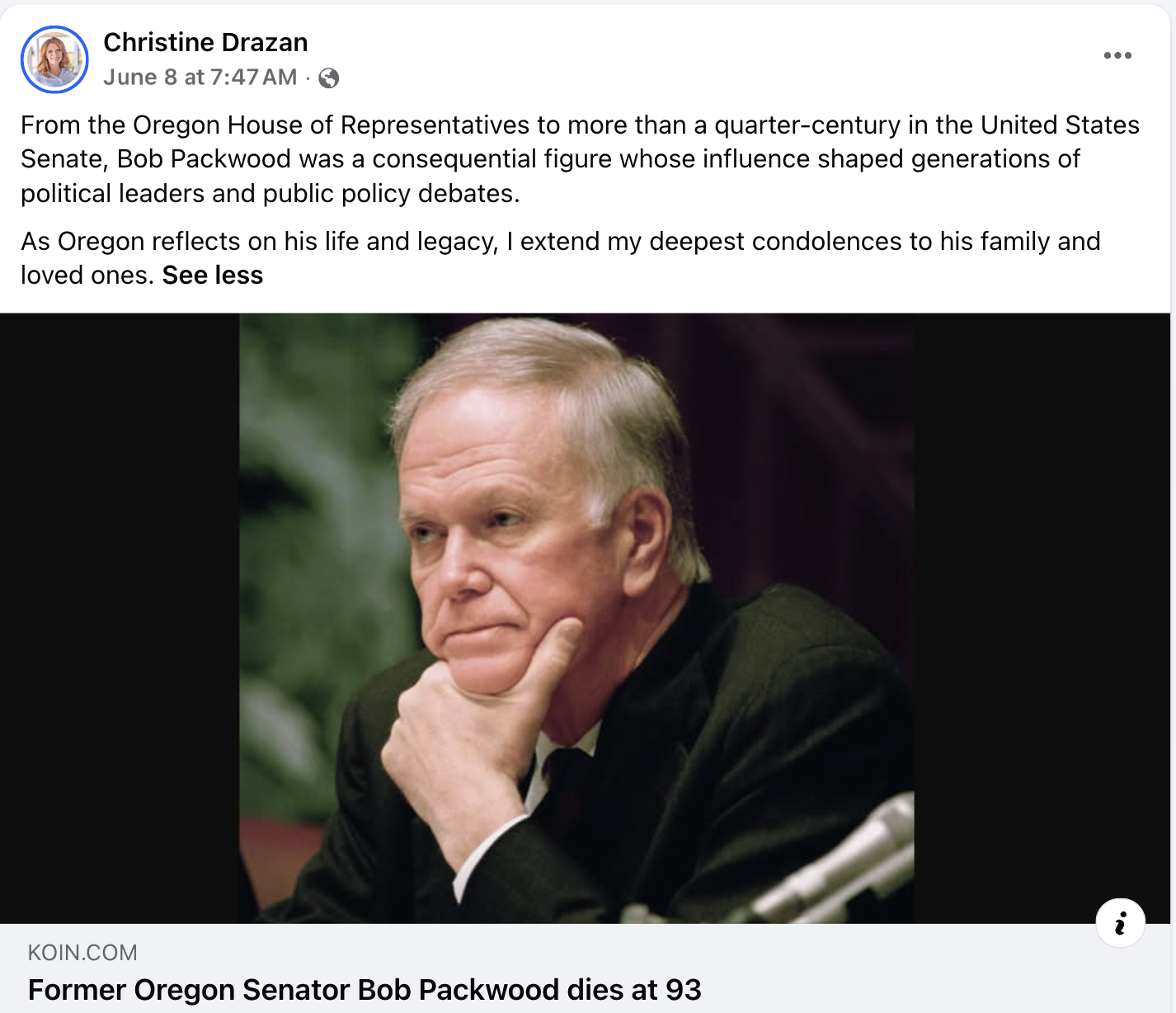
It's been interesting to see how contemporary Oregon Republicans have twisted themselves into pretzels to avoid saying anything too nice about Packwood, the second to last Oregon Republican to win a major statewide election. Christine Drazan, the current OR GOP nominee for governor who needs to attract the votes of moderates in the Portland metro area, let the word "consequential" do a lot of work in this milquetoast post marking Packwood's passing.
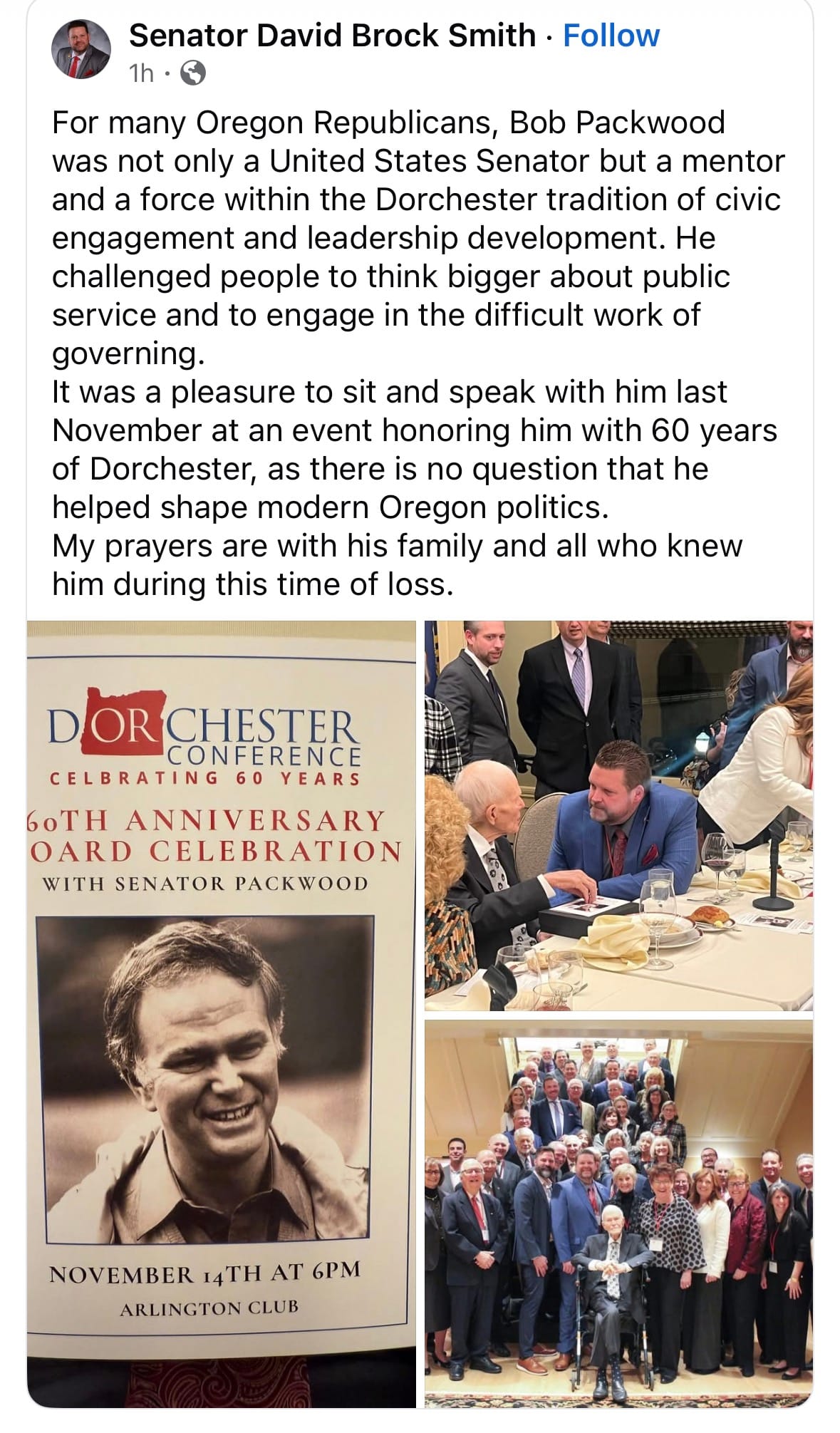
David Brock Smith, the OR GOP nominee for Senate in 2026, came the closest to identifying himself with Packwood's general approach to governance. His line about "the difficult work of governing" is likely a dig aimed at the anti-government right wingers in his district who have made accusing him of being a puppet of the Chinese Communist Party one of their favorite pastimes.
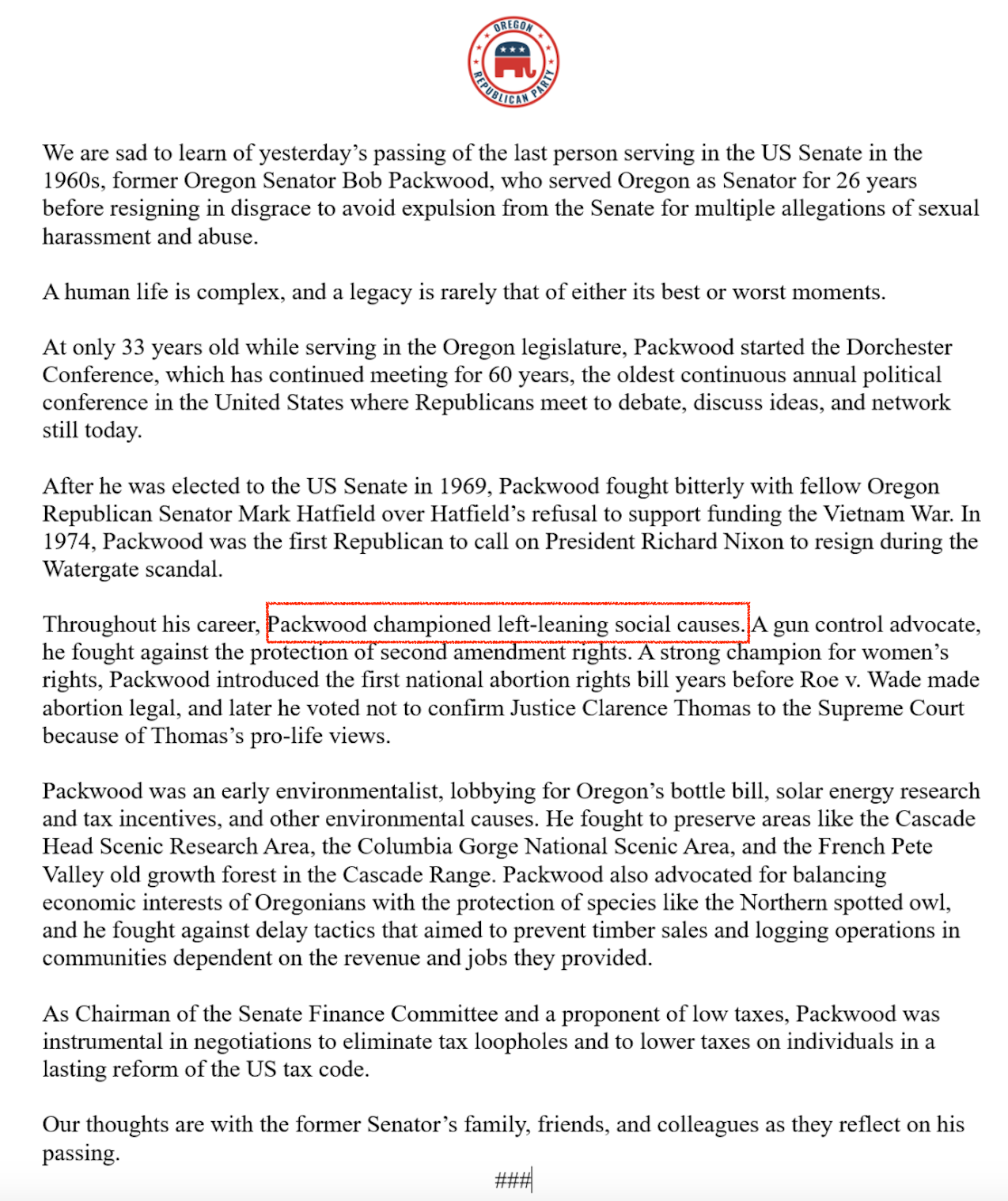
This official statement from the OR GOP, meanwhile, was fairly straightforward (if a bit passive aggressive) in creating space between themselves and that "left leaning" gun grabber, tree hugger, and baby killer. Kudos to them, though, for at least acknowledging Packwood's actions that resulted in his expulsion from the Senate.
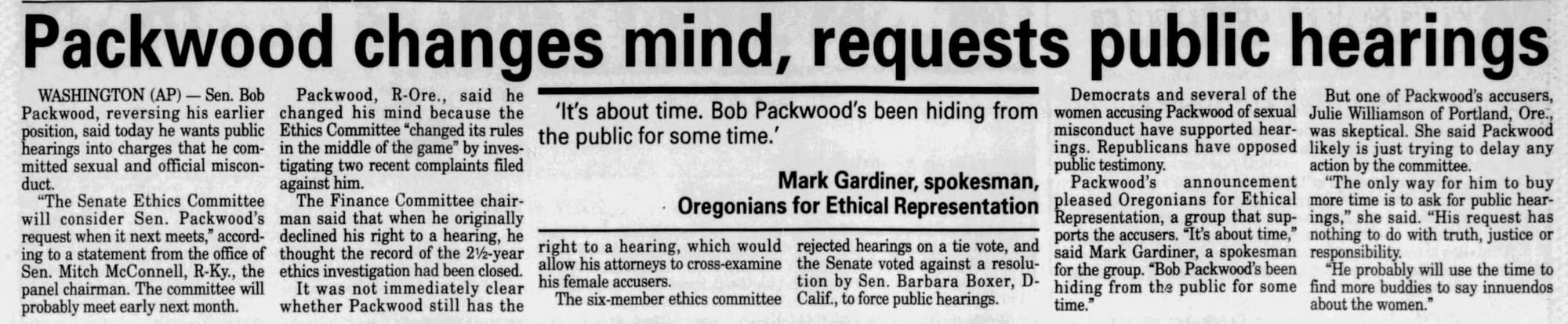
I want to tell one final, too good to be true, story that I've stumbled upon during the course of my research on Walter Huss. In the early 1990s a former fiscal director for the city of Portland named Mark Gardiner founded an organization called "Oregonians for Ethical Representation" devoted to surfacing testimony from some of the many women who'd been harrassed or assaulted by Packwood. The OER was instrumental in creating the conditions for Packwood's resignation.
Mark Gardiner is one of the many Oregonians who has graciously given their time to sit down for an interview with me. When I first tracked him down, however, I had no idea about his feminist work with OER. In fact, I was kind of nervous to get in touch with him because his father, William Gardiner, was one of the antisemitic and white nationalist activists who in 1962 worked together with Silver Shirts Walter Huss and Sylvester Ehr to try to steal the Multnomah Republican Party away from Bob Packwood and his coalition of moderates. [Upon meeting him, I quickly learned that Mark's politics are diametrically opposed to that of his father.]
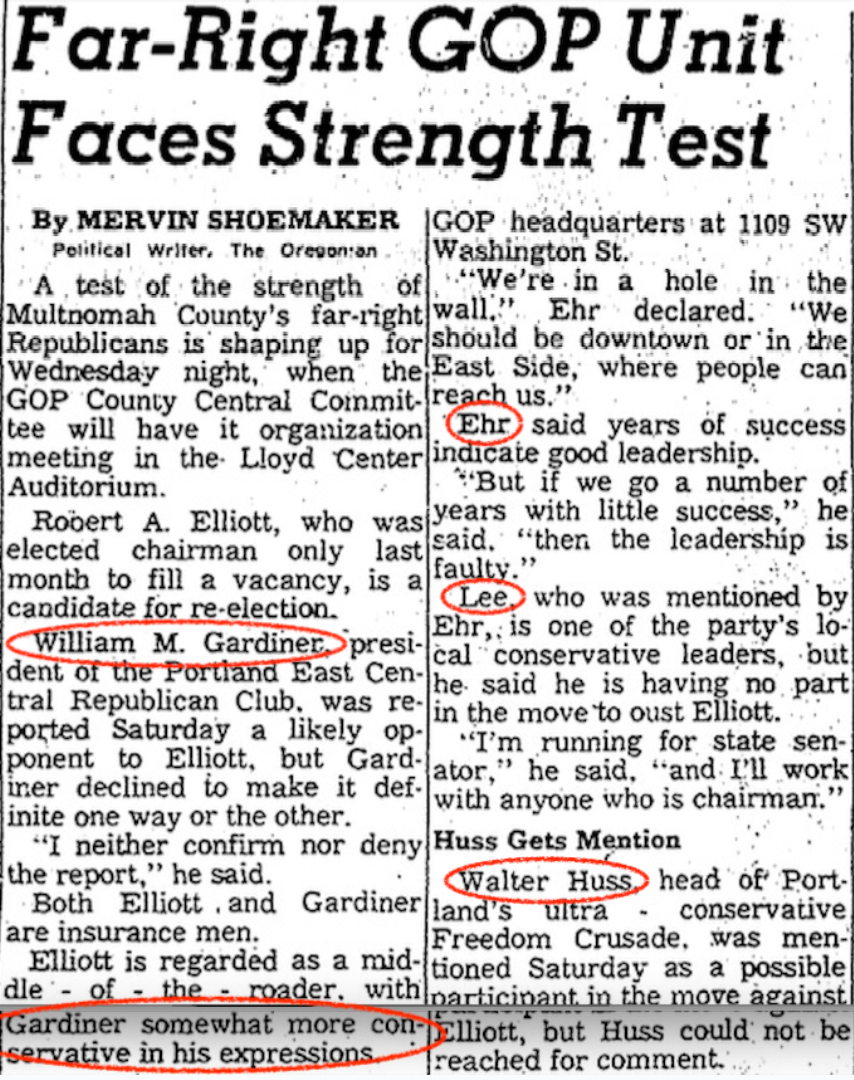
To sum up, in 1962 Bob Packwood began his political career in Oregon getting attacked from the right by William Gardiner. He was then taken down from the left in the mid-1990s by a feminist organization whose spokesman was William Gardiner's son. Oregon politics, like America, contains multitudes.
And this, my friends, is why this blog is entitled "Rightlandia."