Slow Knowledge in the Age of Hot Takes: Some Thoughts on Historians as Pundits
Last Tuesday afternoon my notifications exploded with hundreds of sudden new friend requests from strangers on Facebook, new followers on Bluesky, and new subscribers to my (now abandoned) Substack and this (currently ongoing) Ghost newsletter. At first I thought "oh shit, some MAGA influencer with a huge following just called me a Communist and now I have to go dark for a while until the army of flying monkeys they directed toward me finds some other poor victim." But then I got an email from a former student saying "in case you haven't heard, Heather Cox Richardson just mentioned you on her Politics Chat video!" A far preferable explanation for that sudden notification storm.
This is the specific Bluesky thread of mine that HCR refers to here.
Let's start by acknowledging how strange a moment we're in that more people get their daily updates on the news from a historian of 19th century America than they do from the Washington Post. (Heather Cox Richardson has over 3 million subscribers on Substack, while the WaPo has fewer than 2.5 million digital subscribers.) Next, let's note how strange it is that in the span of just a few hours, over a thousand people went to the trouble of googling me, a random history professor from a small liberal arts college in Oregon, so they could hear more of what I have to say about current events.
Don't get me wrong, I'm flattered by folks' interest in what I have to say; and I think Heather's daily summaries and historical contextualizations of the political news are immensely valuable. That said, I think she would agree with me that the habits of mind that make one a good historian are related to, but still distinct from the skill set that makes one a good summarizer of and commentator on the fast-moving stream of current events. Heather clearly offers a service that many people find valuable and her posts fill an informational void that many perceive and lament, but what does it say about our current political and media environment that a historian of 19th century America is playing this important civic role for so many people?
In our capacity as professional historians, people like Heather and myself are trained to produce "slow knowledge" rather than "hot takes." Books and articles take years, sometimes decades, to write. They go through multiple rounds of peer review and revision, their final versions not seeing the light of day until dozens of other experts in the field have offered critical feedback. Historical knowledge changes over time as people uncover new archival information and offer new analytical perspectives, but it changes at a very slow and incremental pace. Rarely, if ever, does a new historical interpretation emerge that would merit a fire-engine emoji and a "BOOM: BREAKING NEWS" on social media.
Regardless of whether it's a good thing or a bad thing, it's undeniably "a thing" that professional historians like HCR, Joanne Freeman, Kevin Kruse, Timothy Snyder, Ruth Ben-Ghiat, and many others have come to play an outsized role in the Trumposcene era as commentators on and interpreters of current events. In January of 2021 (an "interesting time" to be reflecting on US history) I wrote the following short piece for a blog run by the Journal of the Early Republic meditating on the relatively new phenomenon of "historians with large social media followings." While much has changed in the intervening five years, it still reflects my ongoing ambivalence about this whole "Twitterstorian" thing. [I have made a few minor edits to that 2021 piece. If you want to read the original, it's here.]
“What hath God Wrought" was the first sentence that traveled along Samuel Morse’s telegraph wires on May 24, 1844. Morse's expression of amazement and (perhaps?) dismay often pops into my mind when I’m on Twitter—like on a morning when I open the app to discover that a 280-character thought I’d had while brushing my teeth had gone viral overnight and been seen by a few million strangers while I slept; or when Bruce Bartlett, a Reagan Administration official I’ve never met, politely corrects me on some detail about 1980s politics I’d gotten slightly wrong; or when a tweet about the history of American conservatism elicits swarms of far-right trolls who’d been summoned like flying monkeys to my timeline by some right-wing Twitter celebrity boosting their angry online brand by feeding me, their “far-left Communist brainwashing libtard Professor” du jour, to the MAGA lions for clicks.
Just as Morse’s invention did in the antebellum era, Twitter has sped up political time and connected geographically dispersed people in new and exciting ways; and it’s also widened and inflamed existing political divisions, making glaringly apparent the extent to which Americans today are alienated from and angry at one another. Twitter is, of course, just the latest in a centuries-long series of socially and politically disruptive innovations in the area of communication technology, but it has transformed my life, as both a historian and a citizen, more than any other technological transformation I’ve lived through in my 50+ years.
Until August of 2018 when a thread I wrote on the History of American Conservatism went viral, my experience of Twitter/social media was far different—and in many ways more pleasurable—than it has become since then. [Note: this was written in 2021, two years before Elon Musk bought Twitter and quickly turned it into a frictionless vector for right wing propaganda and reality-distorting disinformation, thereby driving most people who care about empirical accuracy off of the platform.] Until that 2018 moment of sudden virality, I had about 1,000 Twitter followers—mostly professional colleagues, friends, and former students. I had begun tweeting with some regularity during the 2016 primaries. I used Twitter as a sort of public journal where I noted what I was reading and what I was thinking in the midst of what felt like a historically significant, if increasingly surreal, time in American political history. As a professional historian, I felt called to keep a record of my day-to-day reactions to events that I thought might, in hindsight, come to be seen as significant. I was writing mostly for an audience of future readers, not contemporary ones. I imagined myself as a modest, twenty-first-century version of figures like Harbottle Dorr or Victor Klemperer, ordinary people who lived through interesting times and left behind what we’ve now come to see as invaluable records of what those historical eras looked and felt like from the perspective of a single, unexceptional person. At best, I thought maybe some future historian of the 2010s (or one of my descendants) might find my musings mildly interesting.
In that form, Twitter was just a fun hobby, and occasionally also a place where I found myself having rewarding and informative conversations about history, politics, music, sports, and a myriad of other topics with a small circle of online acquaintances. I thought of my contributions to the platform as both a primary source where I produced a running memoir of my thoughts on current events in real time for posterity, and also a secondary source where I would occasionally put on my “teacher” hat and try to place current events in a broader historical perspective for the small group of friends and colleagues who followed me. This was a new kind of writing for me, and it felt liberating. I felt less constrained by the rules of citation and argumentation that professional historians follow, though I still strove to be accurate and to never intentionally mislead. I did, however, feel freed up to offer lines of interpretation that felt right to me at the time, but which were works in progress.
To put this slightly differently, on Twitter I often found myself speaking in a voice that blended my citizen self and my historian self. Those two identities are inextricably interwoven, of course, because my understanding of what it means to be a citizen of an aspirational democracy has been profoundly shaped by my study of U.S. history, but they are still distinct. There are many pronouncements “citizen me” felt comfortable making on Twitter that “historian me” would not have made, at least yet, in print. After all, every professional historian recognizes that our insight into events in the receding past will ripen, sharpen, and sometimes change dramatically with the passage of time.
To give just one example from my own life, I wrote a piece in July 2018 where I explored what seemed to me to be the outlandish idea that America's tradition of "the peaceful transfer of power" might be the next norm to fall. When I had that thought I remember saying to myself "nah, this is crazy, this will never happen, but I might as well spool it out as a thought experiment anyway." This was 2.5 years before January 6.
 Seth Cotlar
It is a given that any forceful pronouncement about the events of the day (as one tends to make on Twitter) will likely come to look misguided, even foolish, in hindsight and as more relevant evidence is uncovered. So “historian me” always sits on one shoulder saying “you should wait to say something, I’m sure it’s more complicated.” Meanwhile “citizen me” sits on the other shoulder screaming “OMG (today’s latest political outrage) IS TOTALLY UNACCEPTABLE AND HISTORY WILL JUDGE YOU IF YOU DON’T USE THE PLATFORM YOU HAVE AVAILABLE TO YOU TO SPEAK OUT NOW!” It’s been rewarding to see hundreds of other historians who have also put their expertise to use over these past few years to help put the daily chaotic churn of thudding bullshit into historical context for a public that seems more interested than ever in what professional historians have to say.
Even though Twitter itself can often be a demoralizing cesspool of interpersonal awfulness, I think it’s ultimately a good sign that “outspoken historian Twitter” [now, Bluesky] has blossomed during the Trump Administration. The growth of “historian twitter,” I’d venture to speculate, has much to do with our role as keepers and tellers of the nation’s foundational stories about itself. One way to understand Trumpism is as a concerted assault on a host of long-cherished but, as we're now painfully aware, always contested stories about America's (small l) liberal democracy—stories about a nation of immigrants, about the ongoing process of democratization at home and in the world, about progress made toward building a racially, culturally, and religiously diverse society committed to the ideal of human equality. To be clear, these mythic stories are neither entirely false nor entirely true, and a large part of our job as historians is to question and/or complicate such self-congratulatory myths.
But national myths don’t only obscure or deceive; they also frequently function as aspirational bets on a future that draw, selectively but (when done well) accurately, on the past to substantiate them and inspire others to embrace and act upon them. They are political myths we tell ourselves as citizens of a shared polity that finds its grounding and its legitimizing stories in the past. Stories about “us,” stories about “America,” that have the power to move “us” will be stories that build a compelling bridge from the past, into our present, and out into some imagined future toward which we, in our own small ways, are each working. So it’s no wonder then, at a moment when that sense of “us-ness” feels as weak and unachievable as it has in living memory, that people turn to historians to help them understand who “we” have been and who “we” might be in the future. Historians have played that role for centuries, but Twitter has made it possible for them to do that work with an unprecedented immediacy and reach.
Since writing that 2021 piece, there's another dimension to the "What hath God Wrought?"/Samuel Morse/telegraph story that I find myself returning to. Morse, the inventor of the Twitter of his day, was also an inventor and amplifier of a batshit anti-Catholic conspiracy theory about the dangerous foreigners flooding into the country who supposedly posed an existential threat to its existence.
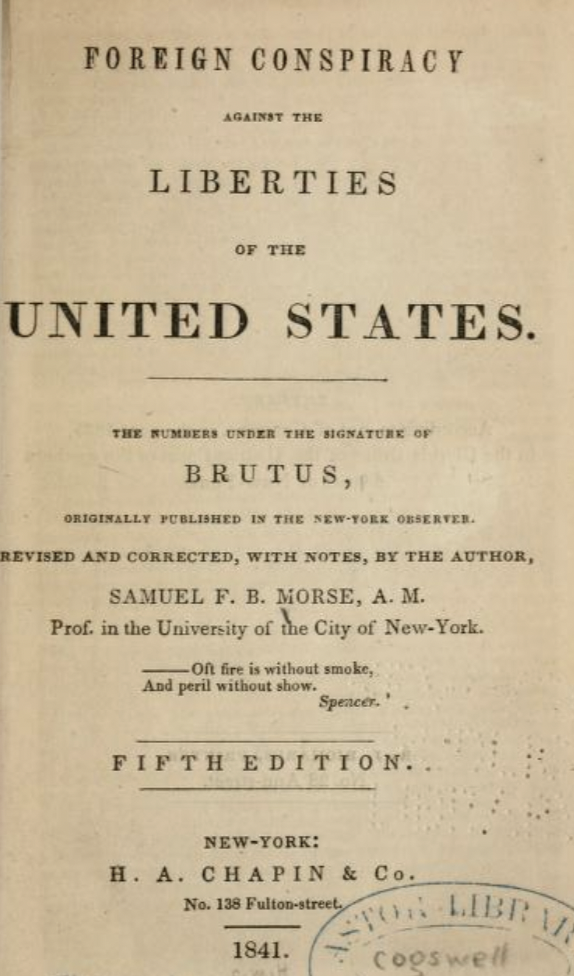
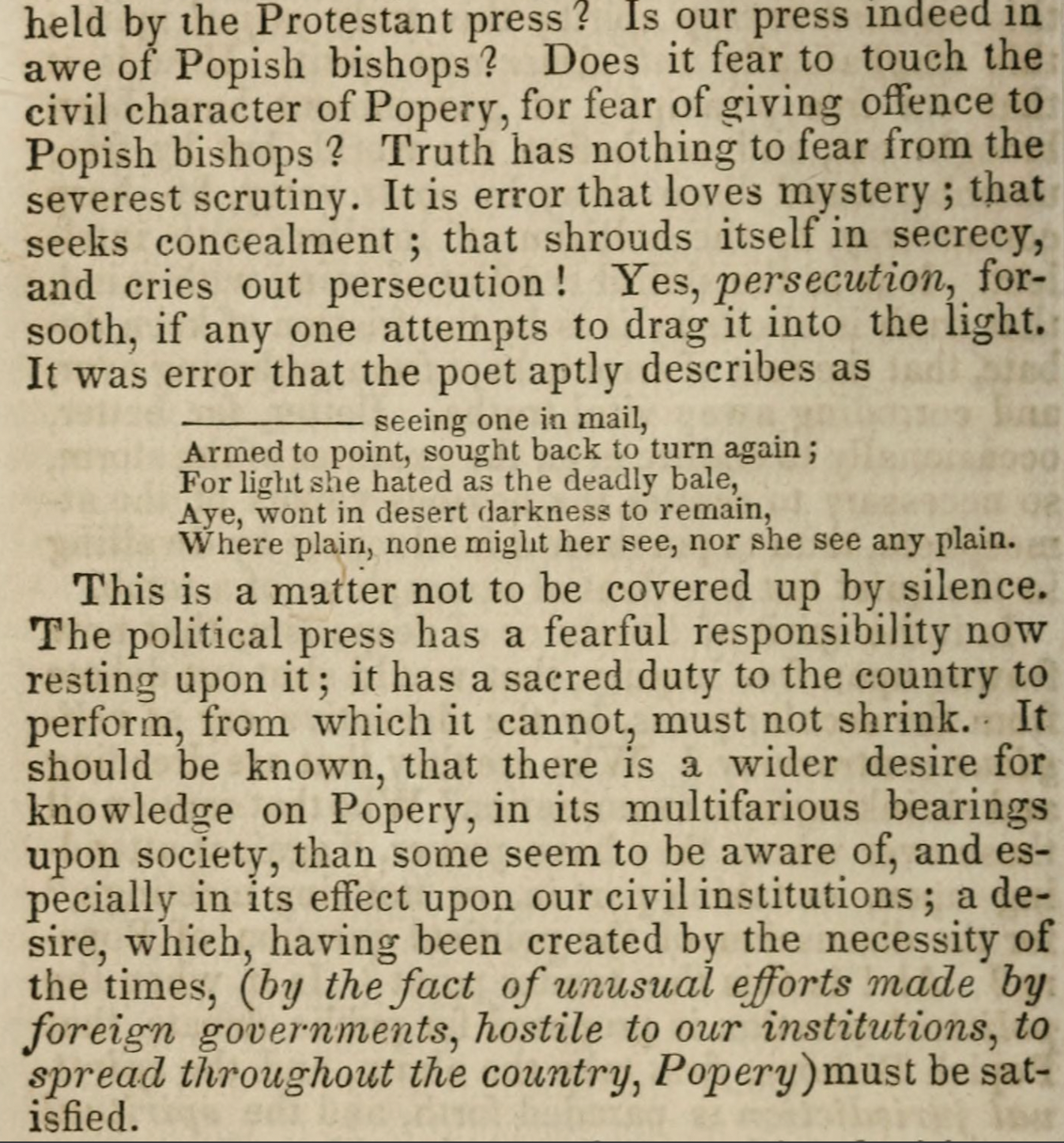
Like today's conspiracy theorists, Morse claimed that the fairly common prejudices and fears about the Papist "other" that he shared with many of his contemporaries were actually "dangerous, hidden truths" that "the people who control the media" are supposedly suppressing. Just as Elon Musk today thinks of himself and other anti-immigrant bigots as being oppressed by working class people of color and non-Christians who supposedly have far more power than he does, Morse encouraged his fellow white Anglo-Saxon protestants to consider themselves the victims of evil-intended "Papists" (most of whom were working class Irish people) who were being coddled by politicians and the press.
It's also worth noting that forty years earlier in the 1790s, Samuel Morse's father (highly respected New England minister and "father of American geography," Jedidiah Morse) was an influential articulator of the batshit idea that there was a secret global conspiracy called "the Illuminati" that was on the brink of destroying Western Christian Civilization. Morse pioneered what would be come a key John Birch Society/Alex Jones talking point that "the Illuminati" had established a major beach head in the United States and was clandestinely working to destroy it. From Morse's perspective in 1798, that wild-eyed, anti-Christian Illuminati conspiracy took the human form of his fellow citizens who were Irish immigrants, admirers of Thomas Jefferson, people who didn't go to church regularly enough, and/or critics of President John Adams.
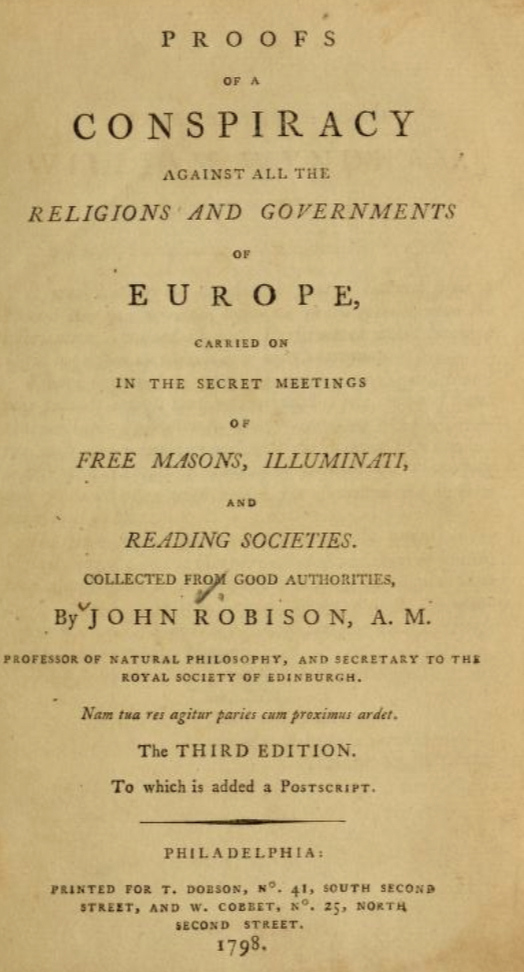
Twenty years ago I published an article about these anti-globalist and anti-immigrant conspiracy theories that played a key role in the anti-democratic, xenophobic backlash that produced the Alien and Sedition Acts of 1798. It's important to note that the key instigators of this conspiracy-obsessed backlash were well-educated ministers like Jedidiah Morse and Yale President Timothy Dwight, working in leagues with cynical right wing propagandists like William Cobbett. In the fever dreams of reactionary Federalists, the "Illuminati" and the "Jacobins" of the 1790s played the same role that "Antifa" and "the Soros-funded radical left" play in the MAGA imagination.
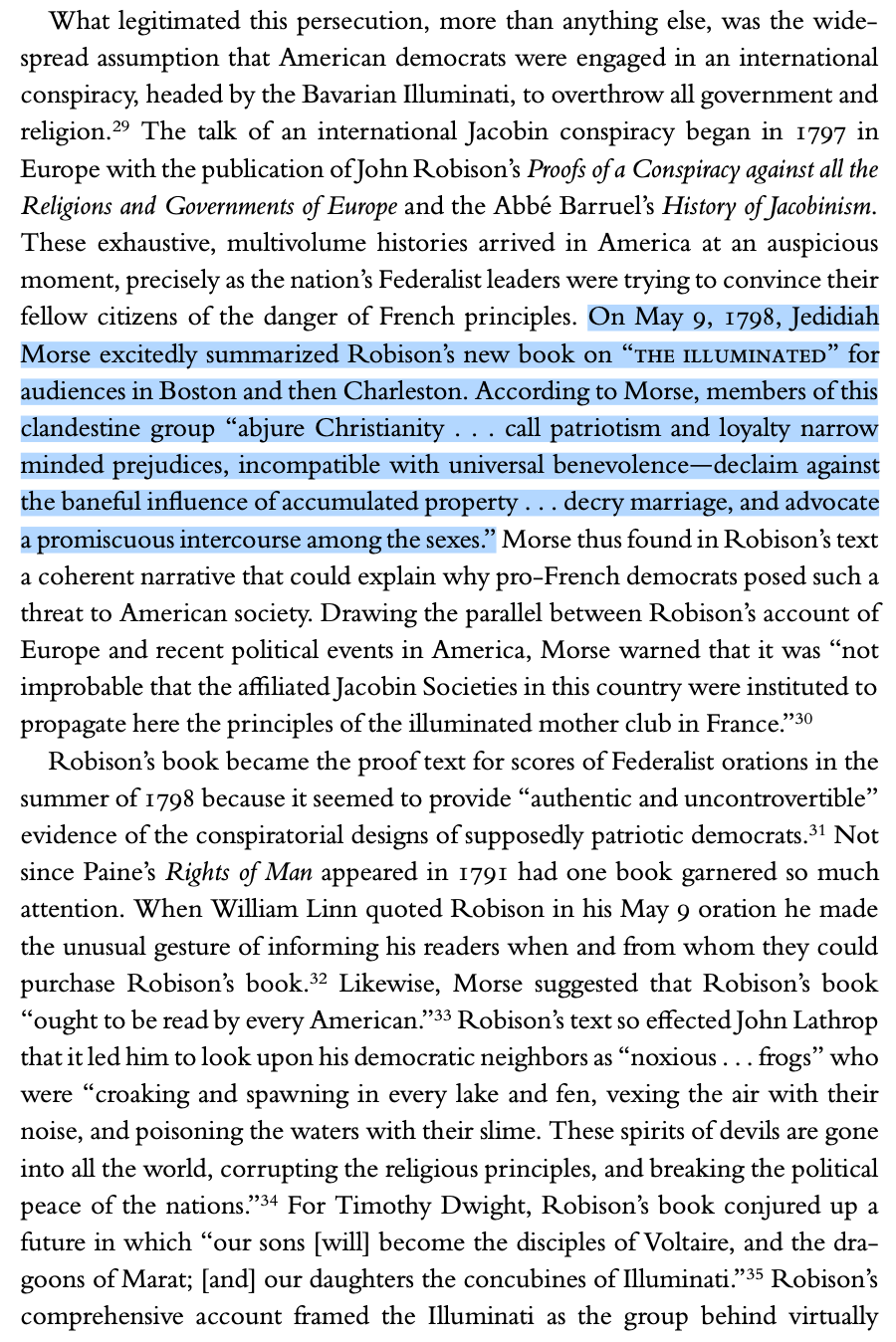
The parallels can be overdrawn, but it's notable that the reactionary, conspiracy-obsessed fever swamp of 1798 emerged in the context of worldwide democratic and anti-democratic mobilizations in Haiti and across Europe, recurring infectious disease scares in US cities, and fears about a possible impending World War. At times of great political and social upheaval, people search for explanations for the rapid changes they see occurring around them. In such environments, conspiracy theories offer useful, shorthand explanations for complicated developments. And as the actions of Jedidiah Morse, Samuel Morse, and Timothy Dwight reveal...even very well educated and accomplished people can be seduced by the allure of conspiracy theories.
The late 1790s was also, like today, a moment when the media environment was rapidly changing. The politics of the late 1790s seemed so heated and unstable, especially to Federalist elites like Jedidiah Morse, in part because the number of newspapers in the United States tripled in the ten years between 1790 and 1800. Just as the telegraph radically shook up the nation's political and communications landscape in the 1840s and 50s, the explosion of independently-edited newspapers in the 1790s did the same thing. It's similar to what happened with the advent of the radio in the 1920s and 30s, television in the 1950s and 60s, and now social media in the 2010s and 20s.
In those moments when technological changes have shaken up old and familiar modes of knowing the world, it has created opportunities for new voices to reach the public. But these changes in communication technology have also stoked understandable anxiety about which voices and outlets one can trust to offer a reliably accurate window onto current events. A historical moment in which people feel like they have access to more information than ever before is also a moment that tends to produce hordes of cynical and ambitious liars who seek to capitalize on that expanding informational market.
If there's one ironclad rule in the professional historians' guild, it's that you can't make shit up. That's why our books and articles have footnotes, so others can check our work. And it's why historians who've been proven to have intentionally misread or fabricated primary source evidence get ostracized from the profession. So at a time when any fool with a camera and editing software can claim to be a "journalist," and when billionaire-owned social media platforms are algorithmically flooded with "journalists" like Nick Shirley or Nick Sortor or Alex Jones or Jack Posobiec or Laura Loomer or [fill in the blank] who also happen to be telling lies or half-truths that are useful to people in positions of power, then it's understandable why people who don't enjoy being lied to would seek out voices they think they can trust to tell the truth. Enter Heather Cox Richardson and other historians who can trade on our profession's reputation for self-enforced empirical rigor.
The historians I know who are active on social media can reliably be trusted to not knowingly lie, but we are NOT journalists. Our information about current events is drawn from the work of journalists who are out in the field interviewing people, making public records requests, and cultivating sources close to events who can offer us unique insights into them. There's a lot of truth to the cliche that journalism is the first draft of history. Democracies depend upon the work of rigorous, independent journalists. They are the ones producing the (relatively) slow knowledge in this era of hot takes, the ones getting multiple sources and going through rigorous fact-checking procedures to ensure that what they publish is as accurate as possible. The analysis of current events offered by someone like Heather Cox Richardson can only ever be as good as the source material she has to work with.
So let me end with a plea to financially support, to the extent that you are able, the working journalists who make it possible for us as citizens (as well as future historians) to understand what is happening in our present moment. We are living in a golden age of conspiracy theories. Conspiracism is a habit of mind that predominates on the right, but is not confined to it. To my mind, modern conspiracy theories, like the antisemitism that usually lies at their core, are a poor substitute for a substantive analysis of how power works. As the old X-Files tag line went, "the truth is out there," but contra that show, the truth is usually far more complicated, grubby, and prosaic than some secret extraterrestrial or paranormal force that "the government" knows about, but has been successfully hiding from you.
Truth is a direction, not a final destination. Truth is a method, not the sole preserve of any individual. Truth is a form of "slow knowledge," not a red-pilling hot take that "changes everything." As Jonathan Swift put it in 1710: "Falsehood flies, and the Truth comes limping after it." In an era when shameless, easily-disprovable lying has become the dominant mode of communication for many of our leaders, it's understandable that it's produced a growing market for voices like HCR and other historians who approach the question of truth with more care, nuance, and respect.