A Guest Post on a Little Known Founding Father of the Christian Nationalist Tradition: Verne Kaub, Willis Carto, and the 1950s Protestant Conservative Underground
by Alex McPhee-Browne (amm256@cam.ac.uk)
The study of the post-WWII US Far Right is a vibrant scholarly field these days for obvious and unfortunate reasons. Though the topic itself can be quite a downer, one great benefit of working on this topic for me has been that the field has attracted many smart young scholars from whom I've learned a lot. I got a chance to meet our guest poster for today, Alex McPhee-Browne, when he was out here in the Pacific Northwest doing archival research at the University of Oregon Special Collections Library, one of the nation's richest repositories of materials pertaining to the history of the US far right.
Alex has published articles on Gerald LK Smith and Kenneth Goff's Christian Nationalism, Merwin K. Hart's fascistic antisemitism, and many other topics that would be of interest to readers of Rightlandia. He is currently a graduate student at the University of Cambridge. A full listing of his published works can be found here.
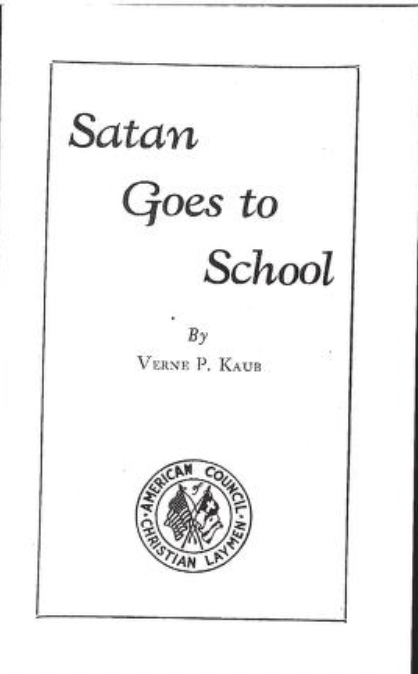
If Alex's discussion of Verne Kaub leaves you with a desire to read some of Verne's writing, a brief 1952 pamphlet of his with the subtle title of "Satan Goes to School" is available at archive dot org. Its attacks on the National Education Association, John Dewey, leftist indoctrination in schools, the idea that America is a democracy, and secularism should ring more than a few bells. Unfortunately, the pamphlet does NOT include an illustration of a backpack-wearing young Satan in schoolboy shorts stepping onto a school bus with a devilish look on his face.
Verne Kaub, Willis Carto, and the 1950s Protestant Conservative Underground, by Alex McPhee-Browne
There is a biographical fact about Verne Paul Kaub that is almost too neat to be true: he was born on the Fourth of July. The year was 1884, in Harrison, Michigan, a sawmill town, as the biographical notes he prepared for himself specify. His father died when Verne was four months old; his mother, who had been a schoolteacher before her marriage, returned to the classroom to earn a livelihood for them both. It was not a privileged beginning, and there is no evidence that Kaub ever traded on it for sympathy.
But the birthday registers differently once you know how he would spend the last twenty years of his life. In pamphlets, letters, congressional testimony, and small-hours correspondence with half the rightist movement in America, he insisted that the Declaration of Independence was not merely a political document but a distillation of Christian theology. He claimed that Thomas Jefferson had been the first statesman in history to inscribe “the importance and dignity of the individual, and the equality of men before the law and in the sight of their Creator” into the founding documents of the republic.
Kaub himself drew the connection explicitly and often. He was not given to irony. He spent his working life in the newspaper trade and in public relations, moving through the smaller cities of Indiana and Wisconsin before retiring in 1949, aged sixty-four, to found the American Council of Christian Laymen (ACCL) and dedicate what he liked to call his “remaining active years” to the fight against collectivism. He wrote two books. He published pamphlets in quantities that ran, eventually, into hundreds of thousands of copies. He corresponded with virtually everyone of consequence on the right, from Carl McIntire to Robert Welch, from Frank Chodorov to Willis Carto. He gave congressional testimony. He spoke at meetings. He was sufficiently well regarded by his peers to earn the description, in a 1960 survey of American right-wing movements published by Ralph Ellsworth and Sarah Harris, of “the Dean of the American Right Wing.” He deserves to be better known than he is.
The archive he left behind, mostly letters, is one of the more revealing documentary windows into that movement’s inner workings. What it shows is a world of considerable intellectual energy and genuine organizational ambition, marked by real theological seriousness and, in places, by something considerably more troubling. It reveals a movement more porous than its respectable Protestant face suggested, and one that contained possibilities its most earnest participants could neither fully acknowledge nor ultimately contain.
The Making of a Controversialist
Kaub’s path to conservative activism was neither sudden nor predictable. After failing to make the grade as an electrical engineering student at the University of Wisconsin, he entered the newspaper trade, working as a reporter, city editor, and eventually editor-in-chief at a series of Midwestern papers before moving, in 1935, to the public relations side at Wisconsin Power and Light in Madison. He read widely throughout these years, accumulated a formidable knowledge of the American libertarian tradition, and was active in anticommunist organizations from 1920 onwards. By the time he founded the ACCL, he had been, as he wrote to a correspondent with characteristic understatement, “interested and active in the fight against radicalism for more than thirty years.” The retirement from public relations was not, for him, a withdrawal from public life but a kind of liberation into it. He had spent twenty years telling other people’s stories. Now he would tell his own.
What distinguished Kaub from the many businessmen, lawyers, and professional anticommunists who populated the mid-century conservative world was the theological seriousness of his argument. He was not content to argue that socialism was economically inefficient or administratively incompetent. His argument was more radical: collectivism and Christianity were metaphysically incompatible, each the negation of the other, and the penetration of socialist ideas into the Protestant churches of America represented not merely a political error but an act of spiritual apostasy. The battle against collectivism was therefore not an option for Christians but an obligation.
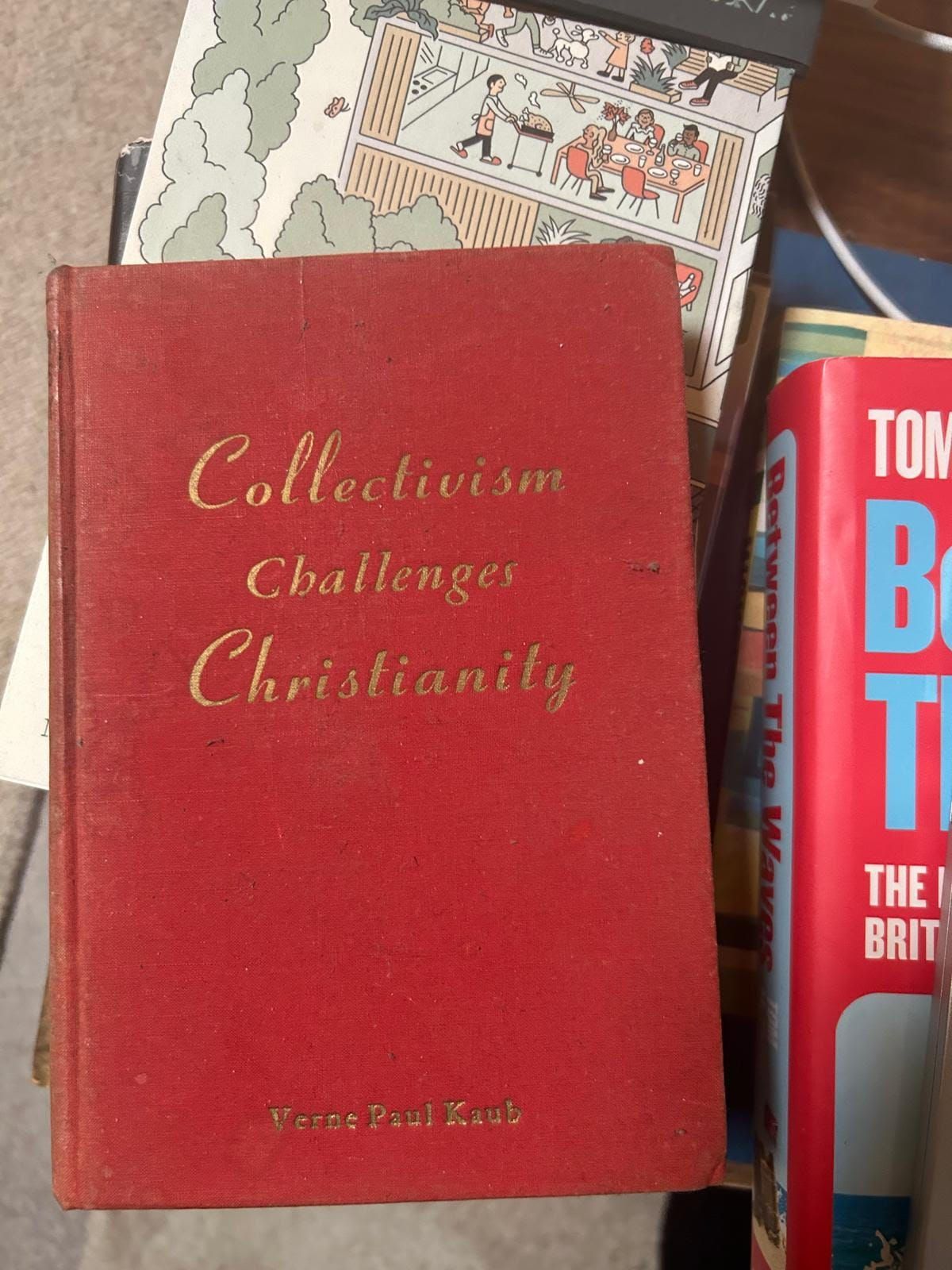
This argument found its fullest expression in his first book, Collectivism Challenges Christianity, published in 1946. It is a remarkable piece of popular theology, written with the clarity that journalism had given him and aimed at a Protestant lay readership that Kaub assumed to be doctrinally orthodox but intellectually unequipped to answer the Social Gospel clergy who had, in his view, captured the mainline denominations. The structure is combative and clear. Marxist teaching is materialistic and anti-Christian at its foundation. Even its milder derivatives, including Social Gospel Christianity, Christian Socialism, and the cooperative movement, trace their lineage back to Marx. For this reason, all Christians have a special stake in resisting collectivism in every form.
Free enterprise was not merely sound economics but “that form of economic organization under which Christianity has its best chance to function.” Freedom of choice was not merely a liberal political value but “nothing but a secular expression for the Christian doctrine of free will.” The republic and the faith were one. To defend one was to defend the other.
The anthropology underpinning this argument is worth pausing over, because it structures everything Kaub wrote and did for the rest of his life. At its core is a doctrine of individual moral responsibility severe enough to make collective welfare provision not merely impractical but spiritually corrosive. The state that takes from the “provident and thrifty” to relieve not only poverty but “to support an arrogant and wasteful bureaucracy” does not merely waste resources; it severs the connection between individual virtue and individual reward, and in doing so corrupts the moral character of both the recipient and the society that sanctions the transfer.
There are moments in the correspondence where Kaub states this position with an austerity that would strike even many conservatives as extreme. In 1953, he described a supposed “exception” that society had come to accept to the commandment against theft, namely the belief that “it is held permissible to take from the provident and thrifty to relieve the poverty of the improvident and indolent, provided only the taking is by consent of the majority of the citizenry.” The language is harsher than anything one would risk in polite company now. The underlying logic has not disappeared. It has simply been made more euphonious.
The Network and How It Worked
The ACCL was a small operation—one man, one secretary, a post office box in Madison—but it functioned as something considerably more than its institutional footprint suggested. Its primary activity was the production and distribution of literature: pamphlets, reprints, and study guides designed for Protestant laypeople who were alarmed by their denominations’ drift toward social activism and keen for documented evidence that their alarm was justified. By the early 1950s the ACCL was shipping literature in quantities that occasionally astonished Kaub himself. How Red Is the Federal Council of Churches?—one of his most widely distributed pamphlets—had, as he noted with a certain satisfaction, entered its hundreds of thousands of copies distributed. The correspondence suggests a man managing a small publishing operation while simultaneously serving as a one-man routing service for the entire American rightist movement.
Reading through Kaub’s letters is to take a guided tour of that movement’s infrastructure. Here is R.C. Hoiles, the newspaper publisher and arch-libertarian, sending a cheque and recommending Bastiat’s The Law, because “[Leonard] Read says it presents this more clearly than any other presentation he has ever read.” Here is Carl McIntire, the fundamentalist broadcaster, discussing the terms of the ACCL’s associate membership in his International Council of Christian Churches. Here is Edward Rumely of the Committee for Constitutional Government, ordering pamphlets by the hundred and maintaining what Kaub describes as “a confidential working agreement.”
Here too is the influential individualist Frank Chodorov, exchanging warm letters with Kaub after meeting at Omaha. Here is Howard Kershner, whose blend of Quaker ethics and Austrian economics Kaub regarded as “by far the best job of presenting issues with the religious and moral aspects pointed out.” And here, in August 1959, is Kaub himself leaving for Chicago to attend one of the early meetings of a new organization whose leader, a “Mr. Welch,” he is meeting for the first time. This, of course, was the John Birch Society.
The functional role Kaub played in this ecosystem was that of a legitimizing node and an information clearing house. His endorsement carried weight, particularly in the Protestant churches where his name was known. He connected activists with one another, directed readers towards trusted literature, and assessed the character of organizations that approached him for cooperation. His letterhead—American Council of Christian Laymen, 609 Sheldon Street, Madison 5, Wisconsin—was, for a generation of conservative activists, a recognizable mark of something between credibility and respectability.
There was, in all this, a complicated relationship with Allen Zoll, the fundraiser and anticommunist agitator who had helped to finance the ACCL’s founding and who had been, from the beginning, an awkward presence in Kaub’s effort to build a respectable movement. Zoll had connections that Kaub found embarrassing: past associations with organizations that had been branded antisemitic or proto-fascist, and a fundraising style that generated as much suspicion as it did revenue. Kaub defended Zoll against critics—arguing that the accusations of antisemitism and fascism were unfair, that Zoll’s earlier associations had been misrepresented—while simultaneously acknowledging, in more candid moments, that the association was a liability.
The arrangement that Zoll proposed in early 1950 was not, on the face of it, a relationship between equals. He would treat the ACCL as a client, supply lists of names, help finance its launch, and “do everything in his power to make it a success,” while retaining a financial interest in the organization’s fundraising. By 1953, Zoll was writing to Kaub to instruct him to keep $250 from a jointly raised $500 and send the rest back personally.
The Circuit Riders—the Methodist anticommunist organization whose founding Kaub attended in the mid-1950s—represented a somewhat different kind of alliance. It was more ecclesiastically anchored, more focused on the specific question of communist infiltration of the Protestant denominations, and better positioned to reach the Methodist laity that Kaub had always seen as one of his primary audiences. Kaub was present at its founding, met the men who ran it, and thereafter maintained the relationship of complementary organizations operating in adjacent territory.
The institutions at the center of his concern were the Protestant churches and the public schools. In 1950, he told a correspondent that these were “the two principal sources of Communist-Socialist propaganda in the United States.” He meant not the Communist and Socialist parties themselves, whose direct membership and influence were modest, but the professional organizations that shaped the teaching and preaching of millions, above all the National Council of Churches and the National Education Association.
This was, characteristically, an argument that located the real danger not in overt radicalism but in the quiet subversion of institutions by people who, in many cases, did not think of themselves as radicals at all. The Communist Party mattered less, in Kaub’s analysis, than the unwitting “fellow travellers and dupes” who were doing the work the Party could not do openly. This framework made the enemy simultaneously more diffuse and more threatening. Anyone who deviated from Christian individualism was, to a greater or lesser degree, serving the collectivist cause.
Communist-Socialist Propaganda in American Schools
Kaub’s second book, published by Meador of Boston, is the more polemical of the two, and in some ways the more revealing. It is a documentary indictment of the National Education Association, arguing through the accumulation of specific citations from NEA publications that the organization’s curriculum guides, yearbooks, and official statements had been systematically infiltrated by collectivist ideology designed to redirect American children away from Christian individualism and toward a vague internationalist socialism.
Kaub’s method is empirical in its form. He works through NEA publications systematically, providing page references and extended quotations, building a cumulative case through the sheer weight of examples. Some of the passages he identifies as tendentious are genuinely striking. NEA materials advise teachers to draw parallels between Russian suspicion of the outside world and the attitude of the early American republic; curriculum guides teaching what he calls the “Marxian doctrine of class struggle” through “sly insinuations that American society is made up of classes”; study materials suggesting that change—“always, of course, in the direction of collectivism”—is “not only inevitable but desirable.” His commentary alternates between sardonic restraint and barely contained outrage. “Merely to point it out is sufficient—no comment is necessary,” he writes of the Russia parallel, in a sentence that barely conceals the indignation behind it.
The book went through four printings in five years. This is a measure of the nerve it was touching, and of the size of the constituency Kaub had assembled. Parents who were alarmed by UNESCO’s influence on school curricula; businessmen funding conservative education initiatives; pastors uneasy about their denominations’ political pronouncements; laypeople who sensed, without quite being able to articulate, that something had changed in what their children were being taught. For all of these, Communist-Socialist Propaganda in American Schools provided documented evidence in a form they could use. The footnote, the page citation, the extended quotation: Kaub understood, with the instinct of a long-time journalist, the rhetorical power of specificity. He was not writing for academics. He was writing for people who needed ammunition, and he gave them ammunition in bulk.
What makes the book most interesting to read now is not the specific charges—some of which are fair, more of which are strained, and a few of which collapse under serious scrutiny—but what it reveals about the epistemological difficulty at the heart of the mid-century conservative activist project. For Kaub, any departure from Christian individualism became, almost by definition, a move toward collectivism. That framework was too blunt to make the distinctions that mattered most. Progressive pedagogy, Social Gospel Christianity, racial egalitarianism, New Deal economics, internationalism, and Soviet communism all appear in his analysis as different manifestations of the same underlying tendency. The consequence of this analytical flatness was that it became impossible to explain, within his framework, why some forms of progressivism were genuinely dangerous and others merely mistaken, or why the NEA’s curriculum choices in 1950 were more alarming than the NEA’s curriculum choices in 1920. Everything was equally alarming. Nothing could be clearly distinguished from anything else.
The Fringe
This is where archival research becomes most indispensable, and most uncomfortable. The published work that Kaub left behind projects an image of principled Protestant conservatism. It was theological in its grounding, constitutional in its politics, documented in its methods, and scrupulous—or so it presents itself—in its associations. The correspondence tells a more complicated story.
Kaub promoted and distributed John O. Beaty’s The Iron Curtain Over America, a book whose animating thesis was that Jewish Khazars had systematically infiltrated American institutions and whose argument drew freely on antisemitic tropes that had circulated in the European far right for decades. He told a correspondent in 1952 that he accepted it “one hundred percent” and directed the ACCL to stock and sell it when “proper arrangements” could be made.
Nor was this an isolated case. He subscribed to and promoted Common Sense, the paper edited by Conde McGinley, whose readership the editor himself estimated at ninety thousand and whose content was among the more virulently antisemitic and nativist on the American right. He sent copies of McGinley’s “Rosenberg edition,” the issue focused on Julius and Ethel Rosenberg and framed in ways that drew on well-established antisemitic conventions, to both Joseph McCarthy and Richard Nixon. A correspondent noted to him, apparently without embarrassment, that Gerald L.K. Smith had recently been invited to teach the largest Men’s Sunday School class in their city.
None of this, by itself, makes Kaub a bigot in the simple sense. The archive does not support a portrait of a man whose religious conservatism was simply a respectable cover for ethnic resentment. His published convictions were genuinely held, his theological arguments were serious in their own terms, and there is consistent evidence throughout the correspondence of a man who was genuinely uneasy about some of his allies’ commitments and genuinely invested in the idea that the conservative cause required clean hands.
He worried about association with figures who had been “branded” as antisemitic. He drew, or tried to draw, distinctions between legitimate anticommunism and the “wilder fringes” of the right. But unease is not the same as refusal. The distinctions he tried to maintain were chronically unstable, and the archive shows the ways in which they repeatedly failed to hold.
The “Dean of the American Right Wing” was also, in this, a representative figure. He inhabited, like most of his contemporaries, a world in which the borders between racial conservatism, constitutional argument, anticommunism, Protestant cultural anxiety, and ethnic nationalism were genuinely blurred—not always deliberately, but sometimes—and in which the movement he was building could not be kept clean of the currents that ran through it.
Carto
The folder bearing Willis Carto’s name introduces a figure of a different type: younger, sharper, more politically calculating, and considerably less encumbered by the theological framework that had given Kaub’s version of conservatism its particular character and its particular limits.
An FBI informant report on Carto from around 1955, when he was in his late twenties and running a small San Francisco outfit called Liberty and Property, is one of the more striking documents in the collection. The informant—evidently a professional—provides a portrait of considerable precision: five feet eight, approximately a hundred and fifty pounds, “hazel eyes, dark brown slightly wavy hair,” with “a cultured voice, considerable warmth, excellent manners.” He is “exceptionally articulate—without being glib.” His intelligence is judged “far above that of other right-wing fanatics personally known to the writer.” Even after “a considerable number of drinks,” his manners hold. He becomes “only slightly more intense in discussing politics than he was when sober.” Reading the portrait, you can see why people found him useful and why some of them found him dangerous.
Then comes the qualification. Carto, the informant continues, has “decided blind spots—the most evident of which is an almost childlike naivete with respect to political realities.” He is prepared to work with anyone—Gerald Smith, Lyrl Van Hyning, Leon De Aryan, Gerald Winrod—in pursuit of a unified right-wing bloc. He professes to dislike antisemites but is “careful to make the distinction that he sees nothing wrong with antisemitism,” a formulation whose logical contortions reward close attention, and which tells you something important about the intellectual environment in which Carto was operating. He believed in political integrity in the abstract, the informant concludes, and was willing to set it aside in practice whenever it stood between him and the next alliance.
Kaub had encountered Carto through the Congress of Freedom and the overlapping libertarian organizations of the early 1950s. By 1959, he was describing Carto in letters as “an old friend and associate” who had recently joined the John Birch Sociey. The ACCL’s 1958 expansion into a Washington research operation compiling voting statistics on Congress—the organization’s most explicitly political move—was, the archive records without apparent discomfort, “underwritten by Willis Carto.” The financial entanglement was real and was not hidden.
What Carto represented, from the perspective of the movement’s internal history, was the gradual displacement of the theological by the ethnic as the organizing principle of American rightist politics. The Liberty Lobby that Carto began building through the late 1950s and into the 1960s retained much of the surface furniture of Kaub’s world—the anticommunism, the constitutional rhetoric, the hostility to the UN, the defense of national sovereignty—while stripping away the Protestant theological underpinning that had given Kaub’s version its internal coherence.
There was no argument from free will, no engagement with the Social Gospel, no attempt to persuade Protestant laypeople that collectivism and Christianity were incompatible at the level of doctrine. What replaced theology, in the end, was race: a racial nationalism that Carto was far less inclined than the “Dean of the American Right Wing” to treat as an embarrassing peripheral tendency. The Liberty Letter—a Liberty Lobby newsletter, to which Kaub subscribed in his later years without, apparently, registering the irony—sits at the far end of a trajectory that Kaub’s own movement had helped to prepare, not by intending it, but by building the infrastructure, normalizing the alliances, and providing the institutional cover that made the transition possible.
The transition was not instantaneous, and it would be too simple to represent Carto as merely the next phase of a project Kaub had begun. Carto was building something different, animated by motivations that differed from Kaub’s at a fundamental level. But the two projects were connected by networks, personnel, shared mailing lists, shared platforms, and the kind of informal trust that accumulates between people who have spent years writing to one another about the same enemies. That connection is part of what the archive documents, and it is a connection that neither man had strong incentives to make explicit.
The Longer View
There is a temptation, when working with an archive like this one, to read it retrospectively. The Protestant conservatism of the 1940s and 1950s can too easily be treated as the respectable face of movements that would later discard respectability. Its theological vocabulary can likewise be read as coded language for motivations that could not yet be stated openly. This reading has genuine force. The connections are real. The personnel overlapped. The institutional networks built by Kaub and his allies provided infrastructure, mailing lists, and a kind of moral legitimacy to figures whose commitments were less scrupulous than his own.
But the reduction is a distortion nonetheless. Kaub’s theological anticollectivism was a genuine intellectual position, grounded in a long Protestant tradition and engaging with questions that were—and in different registers, remain—genuinely serious. The argument that a materialist account of history is hostile to a faith built on the reality of the spiritual; that collective provision severs the connection between virtue and reward that gives individual moral life its structure; that the modern administrative state represents a form of power that is not merely inefficient but spiritually corrosive; these are not merely rationalized prejudices dressed in theological language. They belong to a serious tradition of political thought, and they raised difficulties that the Social Gospel movement’s progressive critics never fully resolved.
What gave the project its peculiar instability was not its core theology but the political environment in which it was forced to operate. The American right of the 1950s was not a coherent intellectual movement with settled principles and clean boundaries. It was a coalition of anxieties—about communism, about racial change, about the erosion of Protestant cultural authority, about the expanding federal state—held together more by shared enemies than by shared convictions. In that environment, Kaub wanted to preserve a set of crucial distinctions. He sought to distinguish principled conservatism from ethnic resentment, constitutional argument from racial politics, and Christian individualism from nativist reaction. Yet those distinctions were always under pressure, and they were never finally secured. The archive is a record of that pressure and of those failures of containment, as much as it is a record of the vision and the effort.
Kaub’s letters, read carefully and without predetermined conclusions, resist both the hagiographic reading that Kaub’s admirers would prefer and the purely cynical reading that sees in the Protestant conservative tradition nothing but ethnic resentment in theological dress. What it offers instead is something more interesting and more difficult: a portrait of a man of genuine conviction operating in a movement whose internal contradictions he could neither fully resolve nor fully ignore, and whose legacy was shaped as much by the company it kept as by the ideas it professed.